


Umsebenzi Online Volume 24, Number 6, 2 October 2025
Contents
1. Statement on the 104th Anniversary of the SACP
3. Cooperatives as a vehicle for food security
Kgotli Mahlake
5. David Moisi: Ready to give my life
Yunus Carrim
8. Walls that speak: revolutionary art in Caracas
Thabile Lenkwane
9. Healthcare in Cuba: What happens when a country puts people before profit?
Exlira Giose-Davids
Red AlertStatement on the 104th Anniversary of the SACP |
 |
Umsebenzi Online Volume 24, Number 6

Contents
1. Statement on the 104th Anniversary of the SACP
2. Defending our sovereignty against US imperialism
Address by SACP GS Solly Mapaila outside the US Consulate General, Johannesburg, 31 August
3. People’s Red Caravan: Building a socialist future is not a promise but a process of struggle!
Solly Mapaila
4. Cooperatives as a vehicle for food security
Kgotli Mahlake
5. Ruth First: revolutionary intellectual, anti-imperialist, and the tasks of the SACP today
Reneva Fourie
6. David Moisi: Ready to give my life
Yunus Carrim
7. Reclaiming the revolution through the People’s Red Caravan: stop the erasure of struggle heritage in Basic Education
Aviwe Rapelang Mohapi
8. Trump’s scramble for Africa: Can the continent escape the legacy of capitalist inferiority in its leaders?
Malefu Mokau
9. Walls that speak: revolutionary art in Caracas
Thabile Lenkwane
10. Healthcare in Cuba: What happens when a country puts people before profit?
Exlira Giose-Davids
Red AlertStatement on the 104th Anniversary of the SACP |
|
 104 Years of consistent struggle for socialism: Intensifying the class battle for meaningful working-class representation and for ending poverty
The Communist Party has stood firm for more than a century, carrying forward the banner of the working class and the poor. The lesson of our 104 years is clear. Political freedom without economic emancipation is incomplete. Democracy without working-class power remains hollow.
Unemployment, poverty and inequality continue to define the lives of millions in our country today. Private monopoly capital continues to loot our resources, exploit labour and sabotage development. Neoliberal austerity and monetary policy suffocate our economy while corruption and lawlessness undermine the gains we won through decades of sacrifice. This cannot continue.
We call on the working class as a whole, employed and unemployed workers, the poor in general, women and men united, the youth, progressive intellectuals and sections of the middle class, and peasants, to intensify the class struggle. Let us unite in defence of our hard-won democratic breakthrough and for the advance to socialism.
Our hard-won democratic dispensation, a key milestone in our revolution, is not and must never be treated as an end in itself. It must serve as a means to obliterate the legacy of colonialism and apartheid to build a better life for all, especially the majority, being the working class and poor, and to establish shared prosperity on a non-racial and non-sexist basis.
In the same way, the National Democratic Revolution is not and must never be reduced to an end in itself. It is a direct route to socialism, rooted in our country’s historical realities, to achieve freedom from capitalist-class domination and exploitation of the working class and control of the state and society at large.
The National Democratic Revolution is a strategy of struggle, transformation and development. It was first conceptualised by the Communist Party as a world movement and here at home in the course of the anti-colonial and anti-imperialist struggle for liberation and social emancipation. But even then, the Communist Party advanced this strategic perspective not for its own sake but in the interests of the working class, the peasants and, ultimately, society as a whole.
The National Democratic Revolution is therefore not the private property of any single organisation inside or outside our movement, nor does any such organisation have an exclusive leadership or other role in it. The revolution is for the people. Everything within it must be about serving the people, and nothing within it must be against the people.
In class terms, the working class, as the majority class and primary but not the sole motive force, must rise to the occasion and establish its leadership of the National Democratic Revolution by democratic means. This must help overcome the crisis of working-class representation that has emerged under the elite pacts that characterise our national political scenario.
To the working class, both employed and unemployed, in urban and rural areas, in the squatter camps, in the labour movement and beyond, young and old, let us build a powerful, socialist movement, and a popular Left front.
Let us intensify the struggle against privatisation in all its forms, including the auctioning off of state assets and the outsourcing of state functions, as well as the replacement of state participation in sectors such as electricity, rail, ports and water infrastructure with profit-driven private interests, including the water tankers associated with the deliberate destruction of or sabotage in the public water provision infrastructure.
Let us intensify the struggle against the conversion of permanent work into insecure and temporary employment, the struggle against labour brokering and the overall struggle against neo-liberalism in all its framing and agendas, including austerity.
Let us tackle the crisis of working-class representation
We must rise with the strength of 104 years of consistent struggle for liberation, democracy and socialism.
The struggle for meaningful working-class representation is not for tomorrow – it is for today. It is a struggle that demands organisation in our workplaces and institutions of learning, mobilisation in our communities and unity in action across our country. This struggle requires us to set the national transformation and development agenda in pursuit of the goals of the Freedom Charter, which remains the basic programme of the National Democratic Revolution.
In that order, we must hold the government and other organs of the state accountable and reclaim our economy for the benefit of the people. To this end, let us strengthen and deploy our collective capacity to provide leadership in the forthcoming National Dialogue process, to secure outcomes that advance the eradication of poverty, achieve large-scale employment creation to end the unemployment crisis and realise, in practice, the right of all to work.
The National Dialogue process must contribute to the radical reduction of inequality and its ultimate elimination. Without advancing these objectives, including resolving the unresolved land question, the National Dialogue will become nothing more than another talk show and a waste of national resources.
Advancing the immediate struggle to confront the crisis of working-class representation requires strategic consistency, with vanguard implementation of our National Congress and Special National Congress resolutions to contest elections directly and more effectively. This is no longer a question of if or when. It is now a question of strengthening our preparations at every Central Committee, Political Bureau and sub-national level of leadership organs to contest the forthcoming local government elections in 2026 on a wall-to-wall basis, as resolved in clear terms by our Fifth Special National Congress in December 2024.
Engagements with our allies on the reconfiguration of the Alliance and on better ways of relating and strengthening our relationship are not a substitute for our National Congress and Special National Congress resolutions but must be pursued, as we are doing, in line with those resolutions. It is a fact that every ally within our Alliance upholds the resolutions of its highest decision-making body, whether a National Congress or a National Conference. It was with a clear appreciation of the situation that the last bilateral meeting between the ANC and the SACP agreed to establish a joint task team on these issues.
The People’s Red Caravan, taking forward village development and tackling the urban–rural uneven development
The People’s Red Caravan is a nationwide village development initiative launched by the SACP in 2025 as a mobilisation platform rooted in working-class and peasant struggles and grassroots community development. SACP Central Committee members led by the General Secretary, and other leaders of the Party from the provincial and district levels and branches, live and work alongside local residents for a full week, called the activation week, addressing poverty, unemployment, food insecurity and violence, to mention but a few, through practical community measures rather than distant bureaucratic rhetoric.
We launched the first Red Caravan Activation Week in Motlhabe Village, North West, in June 2025, followed by a second week in Matibidi, Mpumalanga, in July 2025.
At its core, the People’s Red Caravan rejects patronising charity or top-down delivery. It embodies collective and self-reliant action within communities and calls for community involvement in local development. The programme focuses on sustainable solutions in food security, community safety, health education, cultural and recreational activities, and economic development through local cooperation.
Beyond Motlhabe and Matibidi, the campaign is rolling out to other villages across the country, with each deployment designed to have a lasting impact that strengthens the capacity of communities to fight poverty and build development.
The sustainability and success of the People’s Red Caravan depend on strong and consistently active SACP district and branch structures, serving as the primary organisational mechanism to sustain this work. The SACP must lead in working closely with communities, including traditional councils and leaders who have made land available for productive use, as part of the struggle for development and the fight against poverty and the high cost of living.
The People’s Red Caravan expresses the Communist Party’s determination to mobilise the people directly in their communities to take part in resolving local development challenges.
A call for monetary policy change
The SACP calls for the South African Reserve Bank to be urgently repositioned to play a developmental role, as opposed to the neo-liberal role that has failed, since the adoption of the Constitution in the mid-1990s, to deliver on the constitutional mandate of ensuring balanced and sustainable growth in our nation’s economy. This failure to realise a constitutional obligation must not be allowed to pass without accountability.
Also, it is unacceptable for any institution in our state system to claim independence from democratic policy direction and accountability, while being captive to the dictates of private monopoly capital, other capitalist class interests and imperialist-controlled financial institutions, such as domestic and foreign-controlled commercial banks and the IMFs of this world.
The developmental role that the Reserve Bank should play must include maximum sustainable employment as part of its mandate, explicitly. Its performance must be measured against this employment creation target as a monetary policy goal.
Moving in the opposite direction instead of pursuing a developmental role while announcing a token interest rate reduction of only 0.25 per cent on Thursday, 31 July 2025, the Reserve Bank Monetary Policy Committee, led by its governor, declared, obviously using different words, that it will, going forward, adopt a more conservative stance within the narrow policy of inflation targeting. The 3 per cent inflation target they announced may seem to be within the long controversial 3 to 6 per cent range set by the National Treasury, but it represents a shift towards even greater conservatism within the narrow policy of inflation targeting. There are more problems with this, of which three are worth highlighting, at least for now.
First, it is not the mandate of the Reserve Bank’s Monetary Policy Committee to set monetary policy. That mandate belongs to the executive authority. The conduct of the Reserve Bank’s Monetary Policy Committee is therefore deeply problematic and demands scrutiny. Second, the Reserve Bank failed to state how it intends to achieve the new target. From experience, we know its method will involve raising interest rates.
Third, high interest rates and, as if that were not enough, additional interest rate increases strangle the economy. A high-interest rate regime and additional interest rate increases do not unlock productive investment but instead enrich finance capital monopolies while suffocating workers, households, co-operatives and small enterprises. This monetary policy regime compels families to pay more for mortgages, cars and basic loans, thereby decreasing their capacity to cover daily social reproduction expenses. Co-operatives and small firms are pushed to the edge as the cost of credit becomes unbearable. The outcome is stagnation, which we have faced for a long time now, and persisting high rates of unemployment, poverty and inequality.
The high interest rates regime serves not the needs of society but the greed of finance capital. It protects the capitalist-class elites who profit from debt while the majority endure suffering. Companies retrench workers, the government spends more on interest rate payments than on serving communities, manufacturing de-industrialises and sectors such as construction are paralysed. The economy is throttled, living standards decline and inequality intensifies. High interest rates are not neutral instruments of monetary policy but weapons that entrench underdevelopment and crush the aspirations of the working class, of whom the majority is poor.
Instead, South Africa needs a monetary policy that confronts unemployment and poverty head-on. As things stand, over 12 million people in our country remain without work or have given up looking for it. A just macro-economic policy would support industrialisation and national productive development to create employment on a mass scale. Economic policy must serve the people, not the greedy capitalist-class financiers. It is time to demand a system that prioritises human needs and development over the profits appropriated by a few.
A call for decisive action against crime and corruption
While the SACP has welcomed President Ramaphosa’s decision to establish a judicial commission of inquiry to probe the allegations made by KwaZulu-Natal police provincial commissioner General Nhlanhla Mkhwanazi, the President’s response must not be allowed to distract from the broader crisis.
The crime and corruption crisis that we face as a nation demands decisive, far-reaching action, beyond what the President has announced. Additional measures must include, but must not be limited to, the following.
1. Urgent interventions across the entire landscape of the police, crime intelligence and the criminal justice system at large. These interventions must include forensic auditing and consistent monitoring to isolate and hold unscrupulous and captured elements to account.
2. Stringent measures to enforce full accountability, focusing on all office bearers and officials within every law enforcement authority.
3. The neo-liberal fiscal policy that has contributed to the weakening of law enforcement capacity must be scrapped. Capacity gaps, crime intelligence failures and forensic delays must be addressed. SAPS and other law enforcement authorities must be adequately resourced to win what is now a war declared by criminals, mafias, gangsters, syndicates, and corrupt public office bearers and officials, altogether with the corrupting private sector interests.
4. A clear plan to ensure public safety and security and rebuild public infrastructure, without which millions will continue to live in fear and economic stagnation.
5. Overhaul transformation in law enforcement governance and administration.
There can be no dispute that crime in South Africa has reached intolerable levels and is, in many instances, escalating unchecked. This is coupled with corruption. Conservative estimates suggest that crime costs South Africa at least 10 per cent of total annual output or gross domestic product.
Between October and December 2024 alone, the SAPS recorded 6,953 murders. South Africa is not in the state of war, yet these murders are higher than numerous wartorn regions. Our communities, particularly in the most affected, high-risk provinces like KwaZuluNatal, Gauteng, the Western Cape and the Eastern Cape, remain under siege.
Entire townships and parts of suburbs operate as de facto lawless zones. Major crimes, including gang violence, kidnappings, construction and taxi mafia activity, and extortion, have flourished with virtual impunity. Illegal mining by so-called ‘zama zamas’ has become entrenched.
Criminal syndicates have not merely escalated street crime; they have infiltrated sectors such as state-owned enterprises and, according to the allegations by General Mkhwanazi, also law enforcement authorities, including high-ranking officials and office bearers.
Rail infrastructure was stripped to skeletons. This includes two-thirds of the overhead rail cables, costing billions, which were looted. This looting rendered Metrorail and Transnet infrastructure and operations inoperable or nearly inoperable in many corridors across the country. This has severely affected workers and the economy.
In too many areas, law enforcement is paralysed or compromised. Local communities are virtually defenceless, while top public office bearers enjoy 24-hour state-provided armed protection.
Dockets languish, prosecutions falter, and criminal networks tighten their grip, all sabotaging justice. The justice system, prisons included, is rife with bad influence, crime and corruption, while top criminals continue business as usual.
Conviction rates in major crimes remain shockingly low, often around 10 per cent or less. Let us all rise, protect ourselves and defend our country against the criminal, mafia, syndicate and gangster networks, as well as against the failure of the government and law enforcement authorities to stop the rot and guarantee public safety and security. This must be an immediate objective of our present struggle to achieve complete freedom and social emancipation. Let us build maximum working-class unity and mobilise the broadest possible patriotic and popular Left fronts.
Unite for gender equality and to end gender-based violence in all its forms
In this National Women’s Month of August, we reaffirm that our struggle is a struggle for gender equality, a struggle to end patriarchy and the discrimination of people based on their sexual orientation, and a struggle against gender-based violence and femicide. This struggle is a central pillar of the National Democratic Revolution.
It is intolerable that South Africa continues to rank among the most dangerous places in the world for women. For example, between January and March 2025 alone, police statistics recorded 966 women murdered and more than 9 000 reported rapes. The majority of gender-based murders are intimate partner femicides, and in most cases, the perpetrators are not imprisoned.
We are not just talking about figures here. We are talking about people, human beings. Gender-based violence is a national disgrace and a brutal assault on the lives of working-class women, girls, mothers and sisters who have played decisive roles in our liberation struggle. As a tribute to their courage, the SACP calls for an all-out mobilisation in every community, workplace, campus and rural village, to end the scourge and ensure an effective state response.
We call for safety, justice, resources for survivors and an end to impunity. Let us build socialist working-class power to dismantle patriarchal oppression and capitalism, which thrive on exploitation and violence.
International solidarity
We stand with the people of Swaziland in their struggle for democracy and call for an end to the war in Sudan.
The SACP stands firmly with the people of Western Sahara in their struggle for national self-determination, democratic sovereignty and an end to the occupation of their land by Morocco, which is backed primarily by imperialist powers as well as sellouts who have turned against the Sahrawi people after years of pretending to support their struggle. The SACP expresses its unwavering solidarity with the heroic people of Palestine in their just struggle against genocide, land dispossession, colonial occupation and apartheid. In just 24 hours, between 28 and 29 July 2025, the apartheid Israeli settler regime massacred 113 Palestinian people in the Gaza Strip and injured 637 others. This atrocity is part of the continuing genocide that has already claimed the lives of 60,034 martyrs since 7 October 2023, with a conservative estimate of 145,870 others injured. Among those murdered are patients killed in or while seeking care in hospitals and other healthcare centres, as well as children, the elderly and women.
The cruelty of the apartheid Israeli regime is further shown in its deliberate targeting of civilians seeking food and humanitarian aid. By 29 July 2025, 1,179 civilians had been killed while trying to access aid, with another 7,957 wounded in these criminal attacks. These acts are not only war crimes, but they are also crimes against humanity. They expose the true nature of the apartheid Israeli settler regime, which continues its genocidal project with impunity, backed and armed by imperialist powers such as the US, which are complicit in this ongoing slaughter.
Instead of addressing the genocide against Palestinians by the apartheid Israeli settler regime – which has also destroyed Palestinian social and economic infrastructure, including hospitals, healthcare centres, schools, learning institutions and places of worship – Donald Trump, the President of the US imperialist regime, has chosen to fabricate a false claim of white genocide in South Africa.
Not only did Trump and his administration seek to divert attention from the real genocide against the Palestinian people by the apartheid Israeli settler regime, but he also arrogantly displayed his racist attitude by turning a blind eye to the plight of the landless black majority in South Africa, who were dispossessed under colonisation and apartheid, while falsely elevating claims of land confiscation from white people.
The SACP calls for worldwide unity of the working class and all progressive forces against the United States-led imperialist war-mongering offensives, including direct military and trade wars. The SACP reiterates its support for the BRICS Plus partnership, which must become a vehicle to build a just and better world and systematically end uneven global development and the exploitation of one country’s resources and people by another.
The SACP expresses its solidarity with the peoples of Iran, Lebanon, Syria and others resisting the attacks of the United States-backed apartheid Israeli settler regime. We express our solidarity with the people and government of Cuba in their struggle against the United States’ illegal sanctions and criminal economic, financial, trade and investment blockade. We call on the United States to end these sanctions and the occupation of Cuba’s Guantanamo Bay. Similarly, we stand in solidarity with the people of Venezuela against United States-led imperialist suppression and illegal sanctions.
On 31 August 2025, the SACP General Secretary, Cde Solly Mapaila, members of the Central Committee, SACP leaders and members in Gauteng, the YCLSA, the Friends of Cuba Society and Africa4Palestine held a protest outside the US Embassy in Sandton, Johannesburg. The following is a shortened version of the address by the GS.
As we stand at the consulate of the United States of America, the greatest empire, the most lethal force and the greatest killer in the world, we address the US government. We are here to convey a clear message of solidarity with all the oppressed people in the world. We will read a full memorandum expressing our profound sorrow over their deadly actions.
My purpose is to provide context for our presence here. As we speak, the US has encircled the Bolivarian Republic of Venezuela, threatening military intervention. This act is utterly unacceptable. As the SACP, we unequivocally condemn this position of the United States, which violates the national sovereignty of Venezuela.
We say to the people of Venezuela, we stand with you at this critical juncture. We believe in your indomitable spirit and your capacity to overcome imperialism. You have endured numerous struggles against foreign domination, from Spanish colonisation to the subsequent usurpation by the US of your mineral wealth, especially oil.
We engage in a battle that transcends geographical boundaries. While we fight from a different terrain, we stand steadfastly with you in the face of constant threats.
We urge your people to remain united as you confront this adversary. The United States has already deployed thousands of marines to your doorstep. The introduction of warships, including nuclear warships, is highly unacceptable.
As we are aware, Latin America is currently a nuclear-free region. The United States’ desire to proliferate and introduce lethal weapons into Latin America, a region that has condemned it in the strongest terms, is a clear violation of international law and all legal principles, including USA law.
The US political system has been compromised by a criminal and a gangster who masquerades as president, lacking any adherence to law. He is not even governed by international law or the laws of his own country. The behaviour of Donald Trump in the United States represents the most despicable form of governance we have witnessed in recent times.
We have witnessed Venezuela’s preparations for self-defence. Venezuela’s system of socialism is one of the most exciting and innovative socialist models in the world today. It is a mass-based, localised system of socialism that offers a superior system of self-reliance that will undoubtedly succeed in any part of the world.
The US poses a significant threat to Venezuela, not only through its economic influence but also through its direct intervention. The US has been controlling over 27 refineries and 4,200 filling stations (gas) of Venezuela built in the US, effectively controlling its oil industry. This strategic move, implemented after the US seized Venezuela’s oil reserves in the 1950s, has recently been met with resistance from Venezuela, which seeks to regain its independence and control over its resources.
In response to Venezuela’s aspirations, the US has imposed sanctions on other countries that engage in trade with Venezuela. It has even labelled Venezuela a state sponsor of terrorism and drug trade. This baseless accusation serves as a pretext for its continued interference. The US has also been supporting opposition to the government of Nicolás Maduro, even though Venezuela does not engage in drug trafficking or terrorism.
Venezuela’s efforts to rebuild its infrastructure and industry have been met with resistance from the US, which continues to exert pressure on the country. The USA has also been involved in the conflict in Venezuela, supporting various opposition groups and providing military assistance.
Venezuela’s actions have drawn international attention, and the country has been the subject of criticism from various nations. However, Venezuela remains steadfast in its commitment to self-determination and independence. It continues to advocate for international cooperation and a more just and equitable global system.
Venezuela’s struggle against US imperialism is a testament to the resilience and determination of its people. The country’s efforts to rebuild are a beacon of hope for the entire region. The international community must continue to support Venezuela and stand in solidarity with its people.
We are also obligated to stand in solidarity with the people of Cuba, the upright people of Cuba, who have made significant contributions to the development and freedom that we enjoy in South Africa and across many parts of the African continent, including the Middle East. We cannot forget the Cuban people, who are also suffering under the prolonged, brutal economic assault of the United States.
We recall the Cuban military’s valiant efforts to defend the independence of Algeria and Angola, and their relentless struggle for the liberation of Namibia and South Africa. Before negotiating a peace treaty through the United Nations, they faced enormous pressure. They fought against troops from apartheid South Africa and others backed by the US in the Battle of Cuito Cuanavale.
We extend our unwavering support to the Cuban people and express our solidarity with their struggles. Cuba stands as a beacon of socialism in the world, and we are deeply inspired by its achievements and the unwavering commitment of its people.
We urge the South African government to express its solidarity with the Cuban Revolution and intensify trade relations between our nations. We propose establishing mechanisms for more effective cooperation with the Cuban government and the Cuban people. Additionally, we call on the US to cease its interference in the affairs of other Latin American governments.
The Nicaraguan government is currently under constant threats from the United States, which is being assisted by criminal gangs to destabilise the government of Comrade Daniel Ortega. We have also witnessed attempts to manipulate the elections in Bolivia, and we urge the United States to refrain from such actions.
We also wish to address developments in the Middle East. The US continues to support the Zionist Israeli regime and its genocidal attack on the people of Palestine, particularly in Gaza. Last night, even in the early hours of this morning, the Israeli regime has been bombing different parts of Gaza, continuing to kill women and children, innocent people who they have characterised as armed individuals. Over 25,000 children of Gaza have been killed by the Israeli regime. They continue to kill them daily. They even kill people who are standing in queues to receive food aid.
The racist, apartheid, genocidal Israeli regime, which lacks any human rights, is fully supported by the American government. They are using weapons of mass destruction. We have witnessed the war Israel launched against the Islamic Republic of Iran, which is equally supported by the imperialist regime of America. The American government targeted nuclear plants in Iran, which are not producing weapons, but rather energy. However, the American government decided to destroy them on the basis that they believed they would proliferate and create nuclear weapons.
However, the US, which has hundreds of nuclear weapons in its arsenal and possesses thousands of warheads, is not even adhering to international norms and standards to destroy the warheads that it has. It desires to be the sole owner of nuclear weapons in the world.
We unequivocally reject the aggressive stance of the US. A few weeks ago, the US deployed its nuclear weapons, nuclear ships, and warships in the Pacific Ocean, surrounding Russia. They have also deployed forces from Japan, which are intended for China. Consequently, the United States has become the most destabilising force in the world today.
This is precisely why our governments, both domestically and internationally, must contribute to dismantling the United States’ intention to assume the role of the world’s police force, a role for which they lack the mandate.
The US frequently declares what constitutes democracy and what does not. Their primary objective is to impose the capitalist system globally. We firmly believe that every country, including Venezuela, Cuba, China, and all others, has the right to choose its economic system. If that system is socialism, then it should be implemented. The United States should refrain from imposing its own authority on other countries.
I recently witnessed an interview on Lebanon. America’s actions have resulted in the destruction of the country of Lebanon. They are collaborating with Israel to bomb Lebanon. They have also assassinated Cde Nasrallah, the Secretary General of Hezbollah in Lebanon. Those who have consistently defended Lebanon against Israeli aggression over the years are now being targeted for annihilation, as they are attempting to do in Gaza.
As the South African Communist Party, we express our solidarity with the people of Lebanon and Syria, who are both enduring constant attacks from the Zionist Israeli regime. In fact, Israel, acting as a destabilising force on behalf of the US in the Middle Eastern region, has reached its target. The primary reason behind their pursuit is the substantial resources that this region possesses, including oil, gas, and other vital resources.
The US is heavily reliant on oil, gas and minerals. Consequently, we should not allow our minerals to be diverted to the US. Instead, we should prioritise the development of our own mineral resources within South Africa. We should sell them as products, manufacture technology, and create essential machinery that is crucial for our country’s growth and development. By doing so, we can avoid the fate of our minerals being weaponised and used to attack various countries.
It is a grave matter that the Central Committee has decided to adjourn for a while and join this protest to send a clear message to the US. We will not tolerate imperialism anywhere else in the world, whether it be in South Africa or on the African continent. In this regard, we stand with all the oppressed people around the world, including those who have been intimidated and threatened, particularly in Venezuela.
People’s Red Caravan: Building a socialist future is not a promise but a process of struggle!
Solly Mapaila
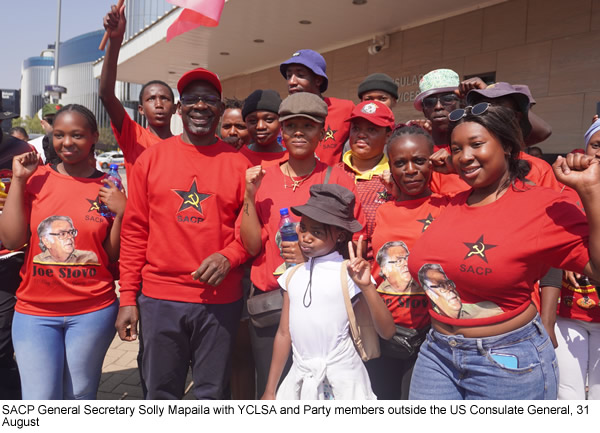 This is an extract from the Political Report to the August Central Committee of the SACP, which will be carried in full in the next issue of African Communist.
Building the socialist future from the ground up
In June, with allied organisations and progressive local structures, we launched the People’s Red Caravan in Motlhabe Village, North West Province. This initiative marks a bold and practical step toward building the socialist future from the ground - through collective ownership, self-reliance, and the organised power of working-class communities. It will not be an exaggeration to say that indeed in this country going forth, we cannot talk about building socialism without the mention of Motlhabe Village – otherwise it will be an injustice to the real construction of organic people’s socialism.
Since its launch, the Red Caravan has helped to lay the foundations of a new people’s economy. From the building of community-owned stores through consumer cooperatives, to the expansion of Village Agricultural Co-operatives (VACs) focused on food production and agro-processing, the initiative is aimed at reclaiming rural and township economies from corporate and elite domination. These are not isolated projects - they are building blocks of a new social order anchored in community development, self-reliance, collective community ownership and co-operative system. Beyond locally based economic transformation, the Red Caravan has also mobilised communities to repair and rebuild social infrastructure - including schools, clinics, ECD centres, roads, and access bridges.
These efforts, supported by traditional councils and grassroots leadership, are reconnecting development to democratic participation and local initiative. Arts and culture, community heritage, and youth involvement have been key pillars of this renewal, although not sufficiently mobilised. At the same time, the PRC is advancing a campaign to establish a co-operative banking network, ensuring that people’s savings and credit facilities serve local development, not the profit motives of commercial banks. These efforts are directly linked to increasing household based incomes, creating household based food production, household based employment, and strengthening self-reliance - through street - and section-based buying clubs, worker and producer cooperatives, and community asset ownership
As we commemorate 104 years of unbroken struggle, the PRC shows that the socialist future is not an abstraction - it is being built, step by step, in our villages and towns. It is being shaped through struggle, solidarity, and the conscious organisation of the working class. The Party remains committed to advancing this transformative programme, anchored in grassroots power and collective ownership, as the pathway to a just and equal South Africa.
Real Co-ops - not pseudo co-ops
We must emphasise that the co-operatives we support are not pseudo ones. We have consistently opposed the abuse of the co-op model to undermine worker rights and bypass labour laws. We supported amendments to the Co-operatives Act to stop this practice. Our vision is clear: worker-owned, democratically governed co-operatives, serving their members and communities — not tenderpreneurs or private profiteers. These co-ops are not a substitute for unions. They are an extension of worker power into the economy itself.
Co-operative banking – taking on capital in the Financial Sector
We are also actively building a co-operative banking movement. We cannot build socialism while remaining trapped in capitalist debt and financial dependency. Our vision includes worker-owned co-operative banking institutions, as part of a national network of co-operative banks, owned by workers, trade unions and co-ops and a financial system built around access, fairness, and democratic control - not the private greed of capitalist banks.
Cde Solly Mapaila is the SACP General Secretary and a former MK combatant
Cooperatives as a vehicle for food security
Kgotli Mahlake
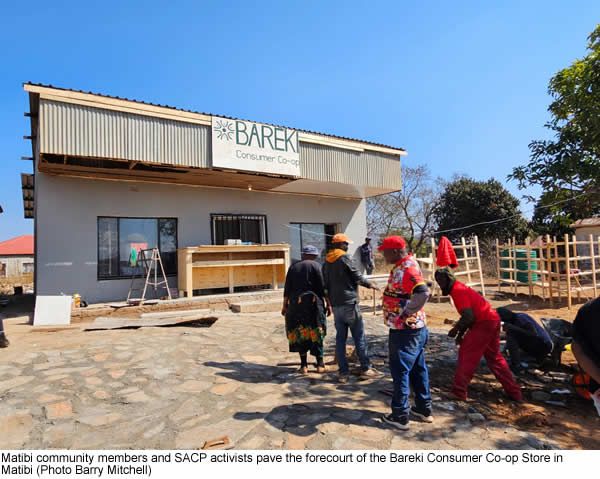 Cde Kgotli delivered the following speech at the opening of the Bareki Co-operative Consumer Store in Matibi at the end of the People’s Red Caravan week.
I am honoured to speak today on behalf of the Matibidi Village Agricultural Co-op Working Group, a collective of farmers, herders, growers, and households who are reclaiming our land, our labour, and our future – through food production, co-operation and self-reliance.
Today we open a store. But behind the shelves and stock, we are opening something far more powerful: A village food system built by the people, for the people.
Food sovereignty begins in the village
What is food sovereignty? It means that we, as a community, have the right and the power to grow our own food, process it, distribute it, and decide for ourselves what we eat and how we eat.
It is not just about planting crops. It is about building a system that:
- Respects the land
- Supports local farmers
- Reduces dependence on outside supermarkets, and
- Keeps food affordable and culturally relevant.
In Matibidi, we are building food sovereignty from the ground – literally.
From seed to shelf: Connecting producers and consumers
For too long, the food we grow here was either wasted, sold cheaply to outsiders, or eaten only at home – while we spend money in shops that bring no value back to the village. Today that begins to change. Through the Bareki Consumer Co-operative, we now have a store that will:
- Stock our vegetables
- Sell our maize
- Buy our eggs, goat meat and fruit, and
- Keep that value circulating within Matibidi.
This is the beginning of a producer-to-store pipeline that gives dignity to our work and power to our people.
Supporting households and growing the Co-op
Our working group has already begun:
- Mapping household producers across the village
- Organising supply of goats, maize, spinach, tomatoes and cabbage
- Planning for bulk planting and seasonal coordination, and
- Partnering with the Bareki store to link supply and demand.
This is not just farming. This is economic reconstruction from below. And every household that plants, every youth that joins a garden, every elder who shares indigenous knowledge – is participating in building our own food system.
What comes next?
We are working with DTCA, the SACP, and traditional leaders to:
- Formalise the Matibidi Village Agricultural Co-operative (VAC)
- Expand access to land – both household and communal
- Build infrastructure like the milling station, greenhouse and community nursery, and
- Train producers in organic methods, crop planning, and co-operative marketing.
We want to reach the point where:
- What we eat is grown right here
- What we sell is processed and packaged here, and
- What we earn stays in our own hands.
Let us sow the seeds of freedom
Comrades, food sovereignty is not a dream It is a practice, a politics, a way of life. Let us treat our land not as a burden – but as a base for power. Let us grow not just for survival – but for freedom. Let us make Matibidi a model of food democracy and local control. Because when we control our food, we control our future.
Cde Kgotli Mahlake is a young emerging farmer from Matibidi, Mpumalanga
Ruth First: revolutionary intellectual, anti-imperialist, and the tasks of the SACP today
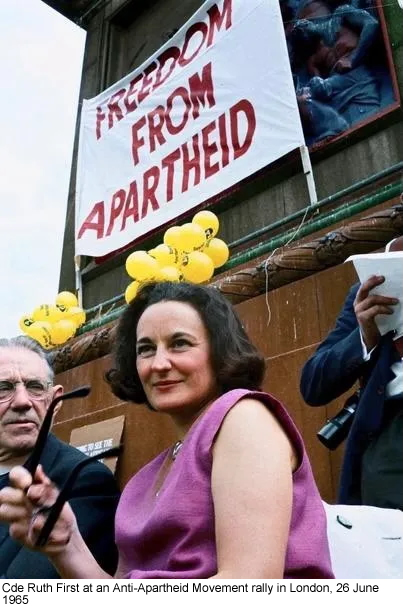 Reneva Fourie
In moments of profound social change, certain figures emerge whose lives illuminate both the struggles of their time and the enduring principles that continue to shape the present. One such figure is Ruth First, whose intellectual rigour, political courage, and commitment to justice remain a source of guidance and inspiration.
Ruth First’s journey reflects not only the turbulent contexts in which she lived but also the powerful intersections of thought and action that she embodied. This article revisits her legacy, tracing the ideas, movements, and values that defined her contribution, while pointing toward the practices that can still inform collective efforts today.
The international and South African balance of forces
Understanding the global and local balance of forces provides the necessary context for examining how Ruth First’s political biography and formation were shaped. A Marxist-Leninist analysis of the contemporary geopolitical environment reveals a world in a state of profound and contradictory flux. The unipolar moment of US hegemony following the dissolution of the Soviet Union and the socialist countries of Eastern Europe is fracturing, giving way to a nascent multipolarity.
However, this shift occurs within the enduring framework of monopoly finance capital, which remains the dominant, globalised force exploiting labour and extracting surplus value on a world scale. The inherent crises of capitalism – overaccumulation, falling rates of profit, and intensifying class struggle – manifest as rampant militarism, environmental degradation, and the rise of far-right neo-fascist movements as the political weapon of the bourgeoisie against a fragmented working class.
In South Africa, this international context is refracted through a specific and paradoxical national reality as we witnessed intensified efforts of US interference in our domestic affairs. The 1994 democratic breakthrough was a monumental victory against political apartheid, which dismantled the political apparatus of apartheid but left its economic architecture largely intact.
More than thirty years later, the working class and the poor, overwhelmingly Black, continue to bear the brunt of unemployment, inequality, spatial marginalisation, and state violence. The African state, which is predominantly advancing neoliberal policies nationalism, is increasingly becoming a manager of crisis for capital rather than a vehicle for radical social transformation. This has precipitated a deep crisis of legitimacy and a corrosive depoliticisation among the masses, who see a vast chasm between the promise of liberation and the reality of their daily immiseration.
It is within this dual crisis – of global capitalist instability and a local balance of forces being pushed decisively toward a resurgent bourgeoisie – that the revolutionary legacy of Ruth First demands reclamation. Her life and work provide a vital compass for a communist movement navigating this complex and hostile terrain.
Biography and political formation
Ruth First (4 May 1925 – 17 August 1982) was not a salon revolutionary or an armchair academic. She was a cadre of the Communist Party of South Africa (CPSA), later the South African Communist Party (SACP), a journalist a scholar, and an activist whose entire life was dedicated to the overthrow of apartheid colonialism.
Born to communist immigrants, Julius and Matilda First, she was immersed in radical politics from childhood. Her father was a founding member of the CPSA and their home was a hub of political discussion and organisation. This upbringing instilled in her a foundational commitment to Marxism-Leninism, non-racialism and the belief that intellectual work must serve the struggle for liberation.
Her political formation was shaped by the brutal realities of apartheid. As a journalist for progressive publications like Fighting Talk and the Guardian/ New Age, she used her intellect as a weapon, conducting meticulous investigative work to expose the brutal mechanics of the regime: the forced labour system, the inhumanity of the pass laws, and the ruthless exploitation in mines and on farms. Her personal and political development laid the foundation for her ability to consistently bridged theory and practice.
Ruth First as a model of theory and practice
Ruth First embodied the Leninist principle that without revolutionary theory, there can be no revolutionary movement. Her life stands as a model for the essential blend of theory and practice – praxis – that defines effective communist work.
From a Marxist-Leninist perspective, theory is a guide to action. Lenin’s What Is To Be Done? stresses the necessity of a vanguard party capable of developing and applying revolutionary theory. Cde First operationalised this. The party, in her conception, was a collective intellectual body that continuously studied, analysed and theorised from the frontlines of struggle to develop effective strategy and tactics. Her own scholarly work was never an end in itself; it was always in service to the movement, providing the analytical framework needed to understand and defeat the enemy.
Cde First was a quintessential practitioner of praxis. Her theoretical work was directly informed by her on-the-ground activism and journalism. Conversely, her activism was sharpened and given direction by her theoretical rigour. She did not merely study class formation; she organised alongside the working class. She did not just write about imperialism; she lived its consequences in exile and fought against it. This unity of thought and action is the bedrock of effective communist leadership.
Despite her formidable academic prowess, Cde First’s work was characterised by a deep respect for the lived experience of the oppressed. She did not descend upon the masses as an expert from on high. Her methodology involved listening to and learning from workers, peasants and grassroot communities. She understood, in a truly Gramscian sense, that every human being is an intellectual and that the factory floor, the village and the township are sites of crucial knowledge production. Her feminism was rooted in listening to and documenting the specific triple exploitation of Black women, recognising that their race, class and gender oppression were fused into a single experience.
Ruth First’s presence shattered the patriarchal notion that revolutionary theory and leadership are masculine domains. She operated at the highest levels of ideological and strategic discussion, commanding respect through the force of her intellect and the courage of her convictions. She demonstrated that the revolutionary woman intellectual is not a contradiction but a necessity, bringing a critical perspective that enriches and completes Marxist analysis by ensuring the struggle against patriarchy is central to the fight for socialism.
Cde First’s commitment to praxis is reflected in her interventions during moments of crisis, particularly in debates on worker participation and the strategic orientation of the SACP.
Ruth First, worker participation crisis, and the SACP's electoral strategy
The question of electoral participation illuminates a synergy between the historical context of Cde First’s activism and the contemporary decisions of the SACP. Research confirms that Ruth First’s parents were stalwarts of the CPSA, which, before being suppressed, did contest elections in the 1940s with a clear revolutionary socialist agenda aimed at using the parliamentary platform to confront the system rather than to manage it.
For the CPSA of that era and the underground SACP that Ruth First belonged to, participation in bourgeois institutions was always a tactical question, subordinate to the strategic goal of building independent working-class power for socialist revolution. This is in line with the SACP’s current decision to contest elections independently while remaining within the Alliance.
Since 1994, the SACP had subordinated its independent programme to the electoral fortunes of the ANC within the Alliance. This has led to a profound crisis of working-class representation.
The working class votes for the ANC but possesses diminishing actual power over the state and economy. The SACP has been unable to halt the government’s trajectory towards neoliberalism.
Ruth First’s praxis offers a searing critique of this predicament. Her life was dedicated to building independent working-class organisations and consciousness. Her work, like Black Gold: The Mozambican Miner, Proletarian and Peasant, analysed the concrete conditions of the working class to inform revolutionary strategy.
Her legacy calls for a reassertion of independent communist politics, using elections as one terrain of struggle among many to rebuild the hegemonic power of the working class and the poor.
These struggles connect directly to broader mass movements such as the adoption of the Freedom Charter and the People’s Red Caravan, which embodies collective aspirations for liberation.
The People’s Red Caravan and the Freedom Charter
Cde Ruth First was deeply involved in the processes that led to the 1955 Freedom Charter. Her Marxist-Leninist analysis would have seen it as the most advanced platform for national democratic struggle – a revolutionary stage to rally the masses, defeat apartheid, and create conditions favourable for an advance to socialism. The Charter’s opening line, ‘South Africa belongs to all who live in it, black and white’, is a perfect expression of the non-racial communism she championed.
As we mark 70 years since the adoption of the Freedom Charter, Cde First’s legacy forces a critical reading of the Charter’s fate today. A Ruth First-inspired analysis would demand reclaiming the Freedom Charter as a radical tool for mobilisation and critique. It would use the Charter’s unfulfilled promises to expose the neo-colonial character of the current governance trajectory and to argue that its true realisation is impossible within capitalism.
The Charter is a living testament to the unfinished revolution – a revolution that, as Cde First understood, must deepen into a struggle for socialism.
The national dialogue offers an opportunity for people-centred engagement. While reactionary forces would like to hijack it for nefarious interests, the platform should be shaped in such a manner that its content exceeds that of the Freedom Charter in championing the interests of the workers and the poor.
Similarly, the SACP’s People’s Red Caravan programme, an initiative involving party leaders travelling to communities to engage with grassroots struggles, represents a conscious attempt to reconnect with the masses.
The links to Ruth First’s life and values here are potent. The Red Caravan echoes her methodological commitment to listening and learning from the ground up, representing a rejection of top-down, bureaucratic party culture.
However, Cde First’s legacy provides a critical framework to ensure such a programme transcends symbolism. For Cde First, engagement was not a periodic listening tour; it was a continuous mode of existence. The challenge for the Red Caravan is to maintain sustainability. Cde First’s humility demands that its purpose is not just to explain party policy, but to fundamentally reshape that policy based on what is learnt from the organic intellectuals in communities and workplaces. The Red Caravan serves as a vehicle for building independent working-class power, which goes far beyond mere canvassing for votes.
Grassroots-driven campaigns crystallised key values and principles that guided both Cde Ruth First and the liberation movement as a whole.
Values and Principles
Ruth First’s life was a concrete embodiment of core communist values and principles that remain as relevant today as they were during her lifetime.
- Non-Racialism and Non-Sexism: For Cde First, non-racialism and non-sexism were not liberal add-ons but foundational communist principles. She fought for a workers' movement that united across the colour line crafted by capital to divide and rule. She understood that a socialism that did not actively dismantle patriarchy and white supremacy would merely reproduce these oppressions in a new form.
- Intellectual Rigour and Tolerance: She stood for a culture of fierce but comradely debate, critical inquiry and the relentless pursuit of knowledge as essential tools for liberation. This requires intellectual tolerance – the ability to engage with challenging ideas and differing viewpoints within the organisation without resorting to dismissiveness or character assassination, understanding that rigorous theory is forged through contestation.
- Humility and Service: She modelled the principle that the party intellectual serves the movement, learning from the masses and placing her skills at their disposal.
- Unwavering Commitment: Her ultimate sacrifice sealed her commitment to the cause of socialism, a reminder that the struggle requires the highest level of dedication and courage.
- Organisational Discipline, Unity and Democratic Centralism: Cde First operated within a clandestine, vanguard party where internal organisational discipline was a matter of life and death. Her work exemplifies the Leninist principle of democratic centralism: full and free debate on policy and strategy internally (‘democracy’) before a decision is reached; followed by united communication and implementation of the agreed-upon line externally (‘centralism’).
This principle is fundamentally undermined by factionalism, labelling and the creation of groupings, which destroy trust and fracture the organisation into competing cliques. The practice of raising critiques within party structures – not on public platforms – is essential to prevent providing ammunition to the class enemy and to build a culture where issues are solved through debate, not through divisive manoeuvring.
- This discipline was born from a collective understanding that organisational unity is the bedrock of revolutionary strength, enabling the party to present a coherent front and act decisively against a powerful opponent.
Grounding the discussion in these principles allows us to conclude with a call to practice, urging the continuation of Ruth First’s legacy in present struggles.
A Call to Practice
Ruth First’s life was a testament to the proposition that revolutionary change requires the utmost clarity of theory, the utmost courage in action, the utmost humility before the power of the organised masses, and the utmost discipline in organisation.
In a contemporary context defined by capitalist crisis and a deviation from liberation dreams, her communist legacy is an urgent call to action. She calls the SACP and the broader left to a renewed call to practice:
- To recommit to praxis, ensuring theory is tested and refined in the fires of mass struggle.
- To practice genuine humility, valuing organic intellectualism as the ultimate source of revolutionary strategy.
- To champion non-racialism and non-sexism as non-negotiable principles.
- To use instruments like the People’s Red Caravan to genuinely listen and build power from below.
- To reclaim the Freedom Charter from co-option and assert its radical, unfinished demands using the National Dialogue as a vehicle.
- To reassert revolutionary organisational discipline. The current conditions underscore the vital importance of democratic centralism and organisational unity.
The strength to navigate the current complex terrain will be found not in individual grandstanding or factional loyalty, but in the collective will and action that flows from our unity, our theory and our unwavering commitment to the revolutionary cause. This trinity of strengths is our indispensable armoury:
- Our unity is our fundamental strategic weapon. It is the disciplined, active unity of a vanguard that understands its historical mission. It is the antithesis of the divide-and-rule tactics of the bourgeoisie and the only force capable of countering the organised power of capital. It means speaking with one voice to the masses and acting as a single fist against the enemy, transforming the party from a talking shop into a formidable instrument of class struggle.
- Our theory is our compass and our map. It is the scientific socialism of Marx, Engels and Lenin, applied concretely to the South African reality, as Ruth First did. It protects us from the paralysis of empiricism and the opportunism of pragmatism. It allows us to see beyond the immediate crises to the underlying structures of exploitation, to anticipate the moves of our class enemies, and to devise a strategy that is not a reaction to events but a conscious shaping of history.
- Our unwavering commitment to the revolutionary cause is the fuel that drives the entire engine. It is the moral and political conviction that the struggle for socialism is not a career path but a lifelong vocation.
To commemorate Ruth First is to do more than remember a hero. It is to ignite an uncompromising flame of critical, humble, disciplined and militant communist praxis – the only force capable of answering the deep crises of our time and leading the way to a truly free South Africa. Her legacy demands that we wield the weapon of unity, guided by the compass of theory, and propelled by an unshakeable commitment to see the revolutionary cause through to its final conclusion. Honouring Cde Ruth First is to refuse surrender, and to carry forward the struggle until freedom is not a promise, but a lived reality for all.
Cde Reneva Fourie is a member of the Politburo and Central Committee of the 15th National Congress. She serves as the SACP Gender Secretary
David Moisi: Ready to give my life
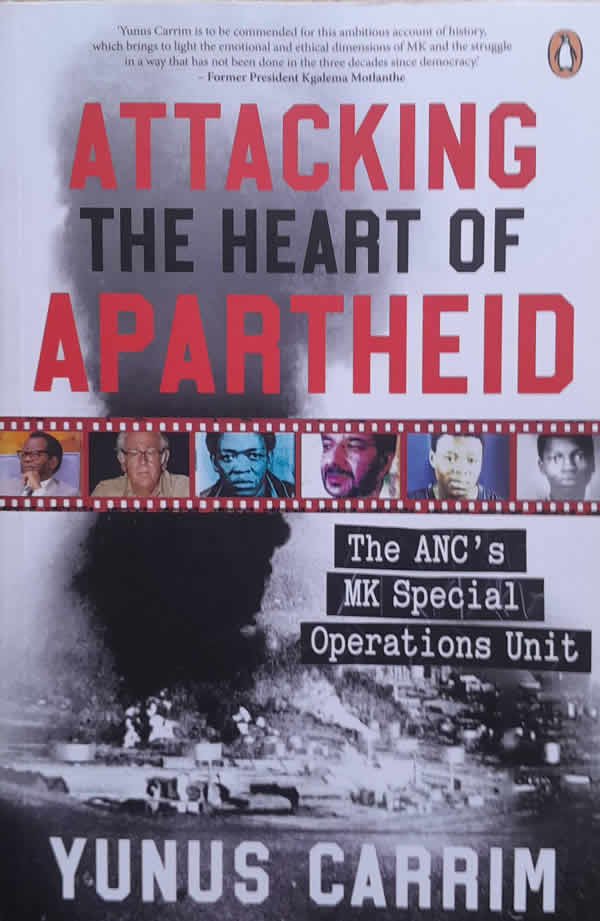 Cde David Moisi, an MK Special Ops combatant was on Death Row, for his role in the spectacular 1990 Sasol operation, regarded as one of MK’s most successful operations. He is acknowledged here as one of our country’s liberation heroes in this Heritage Month. This is an extract from Attacking the Heart of Apartheid: The ANC’s MK Special Operations Unit by Yunus Carrim.
‘I stopped smoking on death row in 1981 when I realised that this thing is controlling me. I’m a slave,’ says David Moisi.
During the hunger strike we only smoked BB [tobacco]. I used to make my zols [hand-rolled cigarettes] smaller. Whether they hang me or not, I’m going to stop, it’s not good for my health. I kept the cigarettes in my cell but resisted, to show discipline, and weeks later I gave up smoking.
Usually, in death row, don’t people want to overindulge in pleasures as they won’t be around for long? ‘Well, anyway [laughter], I stayed with not smoking ever again.’
Moisi was born on 18 March 1956 in Kroonstad, Orange Free State, to a domestic worker mother and a factory worker father. During his school holidays, he used to go with his granny – also a domestic worker – to her work.
I used to play with the baby of the Afrikaner family. Being a child you’re not conscious of these things, and I picked up the baby and kissed her. But I was chided by the mother like you won’t believe it. I kissed babies in the township when I played with them, but this one I can’t kiss. That’s when, somehow, I realised there’s something wrong. So, I grew up with that thing.
He has vivid memories of being chased by white boys on their bicycles and other acts of racism.
He was in Orlando High School in Soweto.
[In 1976] when the uprisings started, it was towards lunch, we saw a military helicopter. We looked into the ‘Wild West’, that’s deep Soweto, and we saw the fires burning. And near us the Bantu Administration people were dashing off, especially the whites. There was so much violence. And there was an old lady teacher, who was shouting that we must go for military training. She was saying this outright; she was mad, mad, mad …
I saw the police baton-charging students and letting the dogs bite them. And the old lady had seen a girl who was trying to run away – and was shot in the head. I saw how the racist regime started shooting at the school kids So, for me that was the last straw.
In 1977, Moisi and his comrades went to Biko’s funeral in Ginsberg in the Eastern Cape. This motivated him more. He told his mother that he was leaving the country. ‘She said you must go to school, not the army. I just agreed, but in my heart of hearts I knew I’ll be joining the armed struggle.’
In December 1977, (ANC veteran) Joe Gqabi organised for Moisi and others to go by train to Piet Retief and skip the fence into Swaziland. About thirty of them ended up in Maputo.
‘We were getting frustrated with these interviews, sitting underneath the tree, to find out if you’re a genuine comrade.’ Two weeks later they were sent by plane to Lusaka.
I was sitting nervously in the plane for the first time. I didn’t want to take the food [laughter] because I didn’t have money. I thought [laughter] we’d have to pay. But I sat strategically to observe what happens … then I realised you don’t have to pay.
He was asked if he wanted to go to school or join the military. ‘I chose the military. I stuck to what I knew I wanted. All of us said military. Also, because you’re viewed as a coward [laughter] if you chose to go to school.’
They were taken to Benguela in Angola.
As the plane was about to land, that’s when the reality of war dawns because all the romantic ideas about guerrilla warfare were sort of off now. You meet the reality of this guerrilla option that you’ve always been after. You see the buildings that have been destroyed and so on. It’s where the fighting with (Jonas) Savimbi (leader of the National Union for the Total Independence of Angola) is taking place. Soon some of you will be fighting there, we were told.
The ANC never arms you before you get political education.
They were moved to the Novo Katengue camp. On 14 March 1979 the camp was attacked by the SAAF. ‘We used to ring a bell to respond if it was an air attack and if it was a ground attack, another way of ringing it.’
Two died and fourteen were injured.
We were asking when are we going to die in our country for our own cause other than trying to defend the Angolans? And this is what caused some of the dissatisfaction in the camps.
They took us [from Novo Katengue] in trucks at night, and no one knew where we were going. Only Comrade (Mzwai) Piliso knew in his vest [laughter].[1] That’s what he was wearing in that heat. It reminded me of our fathers back home, you could see now he’s in the mode of a father.
They ended up in a camp near Quibaxe. ‘Most comrades were falling victim to malaria because we were sleeping outside.’
In 1979, Moisi was part of a group sent for six months training in East Germany to specialise in urban guerrilla warfare.
I sat on Bach’s bed in his house. It’s a museum. We went to places like Mühlhausen, a farm, and a concentration camp. That was horrible.
It got to winter and snow. Those ladies cooking in the camp, they know that, eish, these guys, they’ll come back very sick. So, they used to be very sympathetic towards us, but being a soldier, you have to take all this …
You could see the dedication of these German comrades. They could be sleeping with their families, but they are with you on a snowy night. They would say, ‘Guys, please be serious, we’re preparing you to go and confront your enemy down there’ … They saw our struggle as part of the anti-imperialist chain in which they were also a part. The effort they put into the training! And if it meant punishing you for wrong-doing, they would. Those guys made me feel again why I should be prepared to die for the ANC.
After their return from the GDR, they were taken to the Fazenda camp in northern Angola.
The only thing we had those other camps didn’t was tsetse flies, jurre, during the day, and mosquitoes at night [laughter]. They were on shifts [laughter].
We survived because the ANC succeeded in inculcating this acute sense of political consciousness in us that we have a duty to the struggle and a responsibility to prepare.
But you also begin to question what’s happening to you, where you feel now we are ready, but we are not going home. In East Germany you watched these things about June 16th on German TV – and that makes you mad! That makes you think I’m ready to fight, why is the ANC still keeping me here when I’m so ready to fight? You really feel it’s time to go.
Moisi was selected to be part of the unit to hit Sasol in 1980.
We used to call it umChina. Because this game is betting, gambling … you don’t know the number before, it’s like pulling the number out of a hat. So that’s how you’re chosen. The ANC leadership might have checked your biography and known we want these guys, but you only know when they come to pick you for a mission. I was excited about going back home to fight, what I’ve always wanted to do.
I was ready to give my life, if it means that, but the main thing is we fight; we fight to liberate the people from this misery and humiliation. It’s not that I lacked fear. But bravery is not a lack of fear, it’s the ability to control fear. I was very inspired because I got everything that I wanted from MK. I used to think about my granny, she was shot in Sharpeville. Her one leg was amputated. She loved me to bits.
On 26 October 1980, after the Sasol operation, Moisi returned to South Africa to reconnoitre Caltex refinery and other targets in Cape Town. ‘We wanted Mandela and Sisulu to see the flames from prison.’
He was with Edward Mbundu, Edward Khumalo and Norman Yengeni, who were on another mission. They used a taxi to go to Witbank. But the taxi driver was working with the police – and they were arrested.
I was on the front page of the ‘Wanted List’ so they kept saying I’m the one who’s in the most trouble. One said, ‘I’m not seeing this ID for the first time.’ And it was true. He had asked me for my ID on a train in Piet Retief in 1980. How do you recall from a train full of people one face?
Moisi believes that a comrade from MK’s Special Ops Unit spoke too freely to somebody from the Transvaal Urban Machinery who got caught by the police and revealed a lot to them. That’s how his photo appeared on the ‘Wanted List’. The police knew a lot.
Mbundu, Khumalo and Yengeni were sentenced to ten years.
In a separate trial, Moisi and Johannes Shabangu and Bobby Tsotsobe (from the Transvaal Urban Machinery) were sentenced to death on 18 August 1981.
Were they expecting this?
Sort of. But the judge said you’ll be detained in prison ‘until’ – and you thought it’s detention. I felt relieved in my heart – but then he said until ‘a date is announced when you are going to hang by your necks’. Then you realise – this is it. I just felt condemned!
Their appeal was turned down. Their lawyers sought clemency from the president.
But once it fails, that’s it, you hear them coming with the keys. It’s baadjie and address. Take your khaki jacket and address – they needed to tell your parents through a telegram. That’s the end of the story. You’re going to be there for seven days – then execution. Your presence there is more like a see-saw. Sometimes you hope, but you see how they don’t value a black life, you just think they’re going to hang you. So, you expect the worst.
On 6 June 1983, the sheriff came with the message from the president. The sheriff said the president has decided to – I heard him say ‘ex’ – and immediately thought it was going to be ‘execute’! I just felt, oof, there you are – but he said ‘extend’ clemency to you. The guy dragged the whole thing on unnecessarily. But once he said ‘extend’, we comrades hugged each other. They had to separate us.
Moisi visited death row after 1994. He told Chris Vick that the visit ‘had possibly been a mistake. Too much darkness, my laaitie. Too many voices in my head. The Boers sent me there to die, and I ended up watching others die, some of them even younger than me. I still struggle with that. Why them? Why not me?’
Despite the ANC’s increasing decay in recent years, Moisi is ‘still very grateful to have played a part’ in the country’s liberation. But he was about to be executed? ‘I just found myself there … Many died. I’m still here.’
Attacking the Heart of Apartheid: The ANC’s MK Special Operations Unit by Yunus Carrim is published by Penguin Random House.
Cde Yunus Carim is an SACP Central Committee and Politburo member and former ANC MP
Reclaiming the revolution through the People’s Red Caravan –stop the erasure of struggle heritage in Basic Education!
Aviwe Rapelang Mohapi
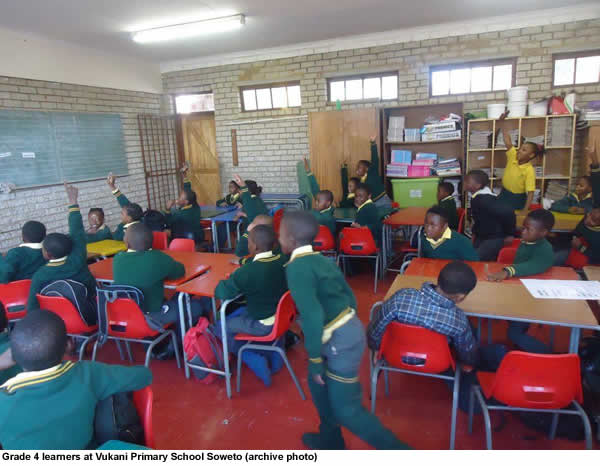 As we mark Heritage Month in September 2025, a time ostensibly dedicated to celebrating the rich tapestry of South Africa's cultural and historical legacy, we must confront a stark reality: our children are being systematically denied the knowledge of their revolutionary inheritance due to a curriculum that is inadequate, biased and ahistorical.
From a Marxist perspective, heritage is not merely a collection of artefacts or folklore; it is the living embodiment of class struggle, the dialectical process through which the oppressed masses rise against exploitation.
In South Africa, this heritage is inextricably tied to the liberation struggle against apartheid – a regime that fused racial oppression with capitalist imperialism, enriching a white bourgeois elite at the expense of the black working class.
As a political activist and a firm believer in the Party's People’s Red Caravan Campaign – a nationwide initiative launched in June 2025 to drive grassroots development, deepen community ties, and build revolutionary consciousness through direct engagement with the people, including activities like health walks, food gardens, infrastructure improvements, arts and culture programs, and economic self-reliance projects – I argue that the Department of Basic Education (DBE) has developed a curriculum that sanitises this history, producing generations alienated from their working class roots.
This is not merely an educational failure, it is an ideological assault on the consciousness of our youth, reducing the rich, complex history of our liberation struggle to sanitised, bourgeois narratives that strip away the radical essence of our people's resistance against capitalism and apartheid colonialism. The SACP's People's Red Caravan initiative has identified this crisis as a critical front in our ongoing struggle for socialist transformation.
By examining the DBE's primary school textbooks and curricula, we uncover a deliberate ideological sabotage that perpetuates bourgeois hegemony. It is time to challenge this pathetic content and demand a curriculum that arms our youth with the tools of revolutionary consciousness, aligning this struggle with the People’s Red Caravan's mission of collective self-reliance, community empowerment and the appreciation of organic intellectualism.
The dialectical role of education in class society
Education is never neutral; it is a superstructure reflecting the base of economic relations. Under capitalism, schools serve to reproduce inequality, indoctrinating the working class to accept their subjugation. In post-apartheid South Africa, despite the formal end of racial segregation, the capitalist state - bolstered by neoliberal policies continues this function.
The liberation struggle, led by the alliance of the ANC, SACP, Cosatu and Sanco, was a profoundly anti-imperialist and anti-capitalist movement. It mobilised workers, peasants, and the oppressed masses against a system where apartheid was the brutal enforcement arm of capital accumulation. Working-class icons like Joe Slovo, Chris Hani, and the countless unnamed workers who fueled the armed struggle and mass defiance campaigns embodied this class war.
Yet, the DBE's Curriculum and Assessment Policy Statements (CAPS) for primary schools (Grades R-7) treat this heritage as an afterthought, if at all. This is no accident; it is a counter-revolutionary manoeuvre to depoliticise history, presenting it as a harmonious progression rather than a site of antagonism. By omitting the struggle, the curriculum fosters false consciousness, teaching children to view their society as a liberal democracy rather than one still riddled with exploitation.
The impoverished state of the education curriculum and its lack of a struggle heritage serve the interests of the capitalist class by denying young people knowledge of successful examples of working-class organisation, anti-capitalist resistance, and socialist construction, making capitalism appear natural and inevitable. As Lenin noted, "The school must become a weapon of the dictatorship of the proletariat." Instead, DBE schools are weapons of capitalist pacification.
The People’s Red Caravan, by engaging communities in practical actions like morning health walks, communal food gardens, and cultural activations, demonstrates how education can be reclaimed as a tool for building alongside the people, fostering the very revolutionary awareness and experiential learning often absent in classrooms.
A close examination of the DBE's primary school curriculum: absence as ideology
Let us dissect the CAPS documents, which govern what our children learn:
- Foundation Phase (Grades R-3): History is subsumed under Life Skills' Beginning Knowledge, where topics touch lightly on personal and family stories, national symbols, and holidays.
- For instance, in Grade 2, children learn about the South African flag and anthem, with direct quotes emphasising "recognising the flag and places where we can see it flying" and "listening and singing," but these are presented as mere symbols without explaining their emergence from anti-colonial resistance. Religious and special days are discussed as they occur, but what is taught about Freedom Day? Mere platitudes about unity, devoid of the blood-soaked strikes, the Sharpeville Massacre, or the role of communist organisers in the Congress of the People. Heritage here is reduced to superficial celebrations, such as mindlessly drawing the flag or singing the national anthem without context.
- Grade 3: "How People Lived Long Ago" includes stories from older family members about food, clothes, and transport, noting "change and continuity," but this is broad and avoids any revolutionary narrative. Critics have pointed out that such activities alienate children from African oral traditions and reinforce Eurocentric norms.
- Intermediate Phase (Grades 4-6): Social Sciences splits into History and Geography. Here, one might expect an introduction to the liberation narrative, but the content is pathetically archaic and evasive, revealing a pattern of ideological sanitisation where the liberation struggle is presented as a moral crusade for "human rights" and "democracy," stripped of its fundamentally anti-capitalist and anti-imperialist character.
- Grade 4: Focuses on "Local History," encouraging projects on community figures, and "Learning from Leaders," featuring the likes of Nelson Mandela who is portrayed as a saintly reconciler - not the MK commander who embraced armed struggle. Direct quote: "A good leader: listens to people; is a servant of the people... is prepared to sacrifice." Mandela's story is stripped of its revolutionary context: no mention of his SACP affiliation or the Freedom Charter's socialist demands. Other topics like "Transport through Time" or "Communication through Time" nod to San rock art as "cultural heritage," but frame indigenous societies as primitive precursors to modern (Western) progress, echoing colonial historiography.
- Grade 5: Delves into "Hunter-Gatherers and Herders in Southern Africa" (San and Khoikhoi) and "The First Farmers," followed by "An Ancient African Society: Egypt." These pre-colonial foci are valuable for reclaiming African antiquity, but they halt abruptly before the European invasion. Heritage in Term 4 is limited to "A Heritage Trail through the Provinces," like the Cradle of Humankind or Frances Baard (a struggle icon), presented as sites or achievements rather than symbols of resistance. Direct quote: "Heritage in sites of significance: Example: Cradle of Humankind... Heritage in people’s achievements: Example: Frances Baard." Robben Island isn't even detailed as a site of torture for political prisoners and defiance.
- Grade 6: Topics include "An African Kingdom: Mapungubwe," "Explorers from Europe" (portraying Da Gama and Van Riebeeck as "discoverers" rather than colonisers), "Trade across the Sahara," and "Democracy and Citizenship in South Africa" (briefly covering the Constitution and rights). "Medicine through Time" highlights indigenous healing, with quotes like "Indigenous healing tends to take a holistic approach... using herbs and plants," but frames it alongside Western advancements without class analysis. A research project on "A South African who has contributed to building democracy" allows for figures like Mandela, but guidelines avoid the armed struggle, focusing on "peaceful" transitions.
Crucially, there is little or no coverage of post-1948 history in primary schools - no apartheid laws, no Soweto Uprising, no role of trade unions in dismantling capitalism's racial facade. The liberation struggle is deferred to Grade 9, where it's introduced via Holocaust analogies, framing apartheid as a moral aberration rather than systemic exploitation. This delay ensures young minds are moulded without revolutionary insight, growing up with "zero understanding" of how people’s power toppled the regime.
Textbook censorship and bourgeois bias
DBE-approved textbooks exacerbate this erasure. Post-apartheid revisions aimed for inclusivity, but they remain tethered to capitalist reconciliation narratives. Mandela is often portrayed neutrally, but in some contexts, especially Afrikaans-medium schools, biases distort the struggle as violent anarchy rather than a justified working-class uprising.
African liberation struggles are "imagined" by few students, as textbooks marginalise them, favouring European "ages of revolution." Deep African pasts, like human origins, are neglected, perpetuating the myth of Africa as ahistorical. The role of the working class in the liberation struggle is systematically erased as students read about political leaders but learn nothing about the strikes, boycotts, and mass mobilisations that formed the backbone of resistance. The contributions of trade unions, the SACP, and working-class communities are relegated to footnotes or ignored entirely.
From a Marxist viewpoint, this is ideological censorship: textbooks under CAPS promote "multiple perspectives" but exclude class analysis. Apartheid is not dissected as capitalism's racial tool, nor is the SACP's vanguard role highlighted. Instead, heritage is commodified and reduced to sites and symbols that obscure exploitation.
When cultural heritage is addressed, it is often reduced to folkloric curiosities or tourist attractions, presenting traditional practices as quaint customs rather than forms of communal organisation that challenged capitalist individualism. The anti-capitalist values embedded in many African traditional societies, such as communalism, collective ownership, etc are ignored or misrepresented, serving the interests of the tourism industry and cultural capitalism. Current textbooks perpetuate the bourgeois mythology of individual heroism while obscuring the mass character of our liberation struggle, focusing overwhelmingly on capitalist elite figures and reinforcing class hierarchies.
Working-class icons like Ray Alexander, Moses Kotane, and thousands of unsung worker-militants are absent from these sanitised accounts. As the Ministerial Task Team on History noted, the curriculum sidelines injustices like land theft and armed resistance, failing to foster identity rooted in struggle.
The colonial mentality lingering in primary education
This inadequacy stems from coloniality - a persistent matrix of power that devalues African knowledge. Primary school curricula are Eurocentric, preparing children to be "foreign in their own land" by prioritising Western canons over indigenous epistemologies. Heritage teaching is tokenistic, confined to annual events rather than integrated subjects. The failure to teach authentic struggle heritage perpetuates the colonial mentality that liberation was supposed to eliminate, with students continuing to internalise Eurocentric historical narratives while remaining ignorant of African resistance traditions and indigenous knowledge systems that challenged colonial domination.
This educational colonialism ensures the reproduction of mental slavery even after formal political liberation, serving the interests of neocolonial capitalism and Western imperialism. Decolonisation demands embedding African history from the foundation phase, using Afrocentric texts to counter epistemicide. Yet, DBE clings to a generic framework alien to our context, reproducing inferiority and disconnecting youth from their revolutionary lineage.
Challenging the DBE through the People’s Red Caravan
This pathetic content is a betrayal of the National Democratic Revolution. Our children grow up ignorant of how the working class, under revolutionary leadership, shattered apartheid's chains. The SACP's People's Red Caravan campaign represents a revolutionary alternative to the bourgeois education system's failures.
Through mobile political education units, community workshops, and grassroots organising, the Red Caravan brings authentic struggle heritage directly to working-class communities. Its educational approach is grounded in historical materialism, helping young people understand the liberation struggle as part of the broader international struggle against capitalism and imperialism. Through the People’s Red Caravan, there will be more focused learning about the SACP's role in the liberation struggle, the socialist content of the Freedom Charter, and the ongoing relevance of Marxist-Leninist principles.
Unlike the static historical narratives in DBE textbooks, the Red Caravan connects past struggles to present-day class conflicts, showing how the tactics and strategies of liberation-era organisers apply to contemporary struggles against unemployment, inequality, and capitalist exploitation. This approach will help students understand that the liberation struggle is not a completed historical episode but an ongoing process that requires their active participation in building socialism.
The People’s Red Caravan reclaims the revolutionary character of liberation heroes who have been sanitised by bourgeois historiography. There will also be more teaching on Mandela's commitment to the SACP, Tambo's socialist vision, and Sisulu's working-class politics. More focus on the contributions of communist militants like Moses Mabhida, Dr. Abdullah Abdurahman, and other SACP leaders who have been erased from official narratives. More importantly, the Red Caravan highlights the role of ordinary workers, peasants, and youth in the liberation struggle, demonstrating that history is made by the masses rather than by individual heroes.
We must challenge the DBE through mass action, i.e. petitions, teachers’ unions, and SACP-led campaigns like the People’s Red Caravan, which embodies the practice of building alongside the people in their communities, organising for self-reliance and demanding curriculum revolution that integrates struggle heritage. This campaign should demand:
- Inclusion of working-class history, acknowledging the central role of workers, trade unions, and the SACP in the liberation struggle.
- Anti-capitalist analysis, presenting the struggle against apartheid as part of the broader struggle against capitalism and imperialism.
- Recognition of revolutionary heroes, giving communist and socialist leaders their rightful place.
- Emphasis on mass participation over individual heroism.
- Contemporary relevance, connecting historical lessons to present-day struggles for economic liberation.
The SACP must expose the class bias inherent in current DBE materials, revealing how textbook publishers, curriculum designers, and educational bureaucrats serve capitalist interests by producing sanitised, depoliticised historical narratives. While fighting for reform within the formal education system, the SACP must continue building alternative educational infrastructure through campaigns like the Red Caravan - community-based political education programs, worker education initiatives, and youth development projects that incorporate authentic struggle heritage as a foundation for building socialist consciousness.
The struggle over heritage education is ultimately a struggle over consciousness and class formation. The capitalist class understands that controlling historical narratives is essential to maintaining hegemony. By denying young people knowledge of their revolutionary heritage, the ruling class hopes to prevent the formation of a conscious working class capable of challenging capitalist exploitation.
The SACP's intervention in education is therefore a crucial component of our broader struggle for socialist transformation. We cannot build socialism without working-class consciousness, and we cannot build working-class consciousness without authentic knowledge of our revolutionary history.
Our struggle for authentic heritage education connects us to similar struggles internationally - from Palestine to Cuba, from Venezuela to Vietnam, where revolutionary movements understand that education is a key battleground in the struggle against imperialism and capitalism. The Red Caravan's educational work contributes to international solidarity by helping young South Africans understand their struggle as part of the global fight for socialism and national liberation.
Revolutionary intervention
The crisis in South African revolutionary heritage education demands urgent revolutionary intervention. We cannot allow another generation of young people to be denied their revolutionary heritage while being indoctrinated with bourgeois ideology disguised as objective education. The People's Red Caravan should continue this vital work, taking revolutionary education directly to the masses and building the consciousness necessary for the completion of our liberation struggle.
In doing so, we honour the memory of our revolutionary heroes and heroines while preparing the next generation for the struggles ahead. The time for polite requests and moderate reforms has passed. The capitalist class will never voluntarily surrender its control over education. We must therefore build the organisational strength necessary to force change while creating alternative institutions that serve working-class interests.
Our children deserve to know the truth about their revolutionary heritage - that the liberation struggle was fundamentally a struggle against capitalism and for socialism, and that the Freedom Charter's call for the people to "share in the country's wealth" was a demand for socialist transformation, not capitalist democracy with a human face.
The revolution continues, and so must our struggle for revolutionary education. Forward to a socialist South Africa!
Cde Aviwe Rapelang Mohapi is the National Education Officer at Nehawu, and is also a writer and political activist
Trump’s scramble for Africa: Can the continent escape the legacy of capitalist inferiority in its leaders?
Malefu Mokau
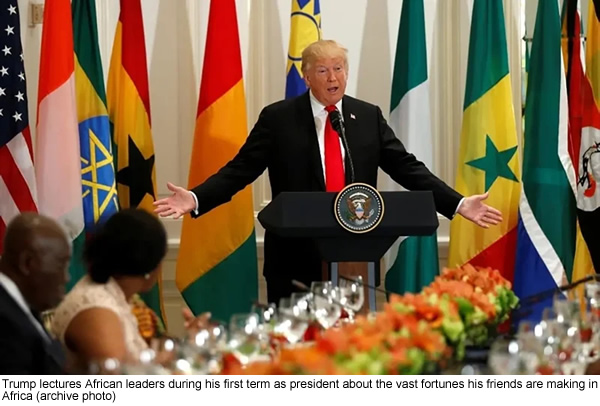 The conclusion of Black Skin, White Mask by Franz Fanon begins with a quote from Marx’s, The Eighteenth Brumaire of Louis Bonaparte (1852): “The social revolution cannot draw its poetry from the past, but only from the future. It cannot begin with itself before it has stripped itself of all its superstitions concerning the past. Earlier revolutions relied on memories out of world history in order to drug themselves against their own content. In order to find their own content, the revolutions of the nineteenth century had to let the dead bury the dead. Before the expression exceeded the content; now, the content exceeds the expression.”
Throughout history, Africans have had to either fight or succumb to foreign power to exist in this world. Whether through slavery, colonialism, apartheid or neoliberalism, the continent has endured centuries of external invasion and exploitation. We are in the 21st century, and yet we can still relate our struggles to Franz Fanon’s 20th-century struggles, who also could relate his work to Marx’s 19th-century analysis of capitalism and class struggles. This kind of occurrence shows that the culture of imperialism in contemporary Africa is still entrenched in our social, political and economic structures.
“The social revolution cannot draw its poetry from the past, but only from the future. It cannot begin with itself before it has stripped itself of all its superstitions concerning the past” (Fanon, 1952).
Some did not believe that things could get any worse with Donald Trump’s second term as the president of the United States of America. However it took him less than 30 days in the White House to turn the world upside down. He lied continuously during his presidential campaign and his victory speech by claiming that he’d “end all wars” which Joe Biden and the Democratic Party couldn’t.
It's nearly 8 months within his term, and yet the invasion of Ukraine and the genocide in Gaza are still ongoing. He went as far as to cut the budget for the United States Agency for International Development (USAID), even though Ukraine was its major recipient since Russia’s military intervention in the country.
Africa was not spared from USAID budget cuts, with countries like Burundi, Mozambique, Eswatini, Lesotho and South Africa being most reliant on the US aid for HIV/AIDS programmes. But, in as much as HIV/AIDS continues to be a public health concern, for how long should Africa depend on the West for survival? Isn’t this an opportunity to strip ourselves of all superstitions that are disguised as aid in our continent? Africa doesn’t need aid; it needs competent leaders who put their people first for the sake of the present and future of its people.
“Earlier revolutions relied on memories out of world history in order to drug themselves against their own content” (Fanon, 1952).
In Sister Outsider by Audre Lorde, there is a quote that goes “For the master’s tools will never dismantle the master's house”. When allegations were made that there is white genocide taking place in South Africa, it showed how divided we are as a country, with white supremacists supporting this Elon Musk and Donald Trump propaganda for their own selfish gains. What was more concerning was how our government chose to handle the matter – the approach that our leaders chose to address Trump’s allegations only exposed our shortcomings to the world. What should’ve been a diplomatic conversation to say there’s no such thing as white genocide in our country, stop spreading lies, became a plea for Trump to “help” us combat widespread poverty and inequalities.
Such tools cannot dismantle dependency – they will only allow us to survive in the global capitalist order. Lorde’s metaphor exposes the inferiority complex that our leaders have towards Trump – they’d rather furnish the master’s house instead of cutting ties altogether and building their own. The reason why Africa continues to be exploited is that it has adopted the capitalist form of transaction that comes with recognition from the West and disregard for real change in our societies.
“May the best man win”, these are the words of the former African Union diplomat Arikana Chihombori in an interview with Al Jazeera. She stated that Trump is a transactional man and African leaders must negotiate good standing deals with Trump for their countries, yet she criticised President Cyril Ramaphosa for looking like a fool in front of Trump. However, our president was no different from the other African presidents of Guinea-Bissau, Liberia, Mauritania, Gabon and Senegal who “behaved” in the master’s house.
They felt inferior to Trump and exposed their weaknesses – that they need him. But do they really? Or are we conditioned to depend on the West? They acted like salesmen, and their main pitch was “we have minerals and we are willing to trade with America”. To make it, clear Trump is not a transactional man: he is an exploiter who threatens countries with tariff increases to get his way. We've seen it play out with Canada and China, who, instead of giving in to Trump's demands, opted for retaliatory tariffs and rapid shift towards non-US markets like Africa.
You are either his friend or get tariff increases. Negotiating and stroking Trump’s ego will not eradicate the poverty and exploitation we faced as a continent, nor is suggesting nominating him for the Nobel Peace Prize. Were they referring to the same man who continues to fund Israel’s genocide in Gaza and bombed Iranian nuclear sites while expecting peace talks? His use of coercive diplomacy under the state of instability and uproar in the Middle East has proven to work against him because now more than before, the world is realising that he does not qualify to be a leader.
Trump has no regard for the other – he believes in making America great again, but which great America is he referring to? When people were enslaved, or is he referring to the period before America had its first black president? We do ourselves a disservice by taking Trump’s statements lightly and calling him crazy, whereas he has continuously threatened to annex and invade other countries, not to mention his plans to take over the Gaza strip like it’s a project. He is impulsive, dangerous and believes in America presiding over the world for his own contentment.
“In order to find their own content, the revolutions of the nineteenth century have to let the dead bury the dead. Before the expression exceeded the content; now, the content exceeds the expression” (Fanon, 1952).
The culture of inferiority that African leaders have shown towards the Trump administration is humiliating. They act as though validation from the West is more important than building their countries’ capacity. The only way to abolish the heritage of inferiority is by burying the cultural logic of colonial capitalism and creating new socialist expressions that reflect Africa’s realities and serve its people. The capitalist masters’ tools should be left to the Western leaders who were born, bred and continue to benefit from the extortion of capitalism. Africa needs a political culture that is not reactive but proactive towards socialism.
The South African Communist Party, through the People’s Red Caravan, is a step towards that – a framework where people interact with policy, not just to be governed by it. It promotes land and resource sovereignty by helping build solidarity across rural communities and townships – linking land struggles to broader issues like food security, water rights, and rural development – proving that the struggle for socialism is rooted in the daily survival and dignity of the people.
This is the alternative we must stand for – we cannot accept capitalist policies that want to privatise public entities for “ better efficiency and service” to continue robbing ordinary South Africans of what belongs to them. We must continue to advocate for a people’s economy that puts land and resources back into the hands of the people. That’s how we will escape the heritage of capitalist inferiority.
Cde Malefu Mokau is a member of the YCLSA
Walls that speak: revolutionary art in Caracas
Thabile Lenkwane
Under the Bolivarian sun, Caracas hums with colour, but these colours are not passive decoration. They are weapons.
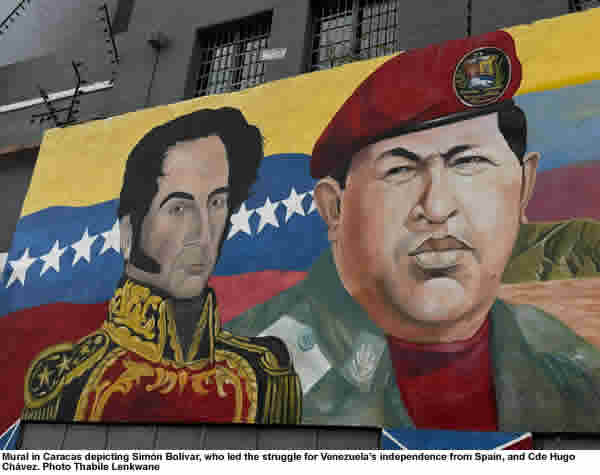 On walls, bridges and building facades, the faces of Simón Bolívar, Hugo Chávez, Afro-Venezuelan revolutionaries and nameless martyrs stare back at the city with defiance. Their painted eyes challenge imperialism. Their clenched fists, slogans and symbols contest the global order that would prefer their silence. Every mural is a barricade against forgetting, every brushstroke a blow struck in the war of ideas.
In Venezuela, the wall is not neutral. It is a public classroom, a newspaper, a rally and a memorial all at once. The Bolivarian Revolution understood, as Marx, Lenin and Gramsci did, that culture is a terrain of struggle. Those who control the image control the story; those who control the story shape consciousness. This is why in Caracas the story of the revolution is not left to textbooks that can be rewritten, or media channels that can be censored; it is inscribed on concrete, brick and steel, where it stares back at the people each day. Here, memory is not confined to museums or archives; it lives in the streets, watching, reminding, urging. And unlike static monuments, these walls are dynamic: new slogans appear, new heroes are added, old images are refreshed. The art evolves as the struggle evolves, breathing alongside the people.
This living gallery of defiance forms part of a wider revolutionary tradition, the roots stretch back to 1917, when the Soviet Revolution exploded not only onto the political map, but onto the walls, trains, and streets of Russia. In Mexican artists Diego Rivera, David Alfaro Siqueiros, and José Clemente Orozco turned public walls into vast historical canvases, telling the story of indigenous resistance, labour struggles, and the dignity of the peasantry.
Their murals rejected the bourgeois gallery system that hid art behind walls and sold it to the highest bidder. They took history out of the hands of the elite and placed it squarely in the eyes of the masses. After its 1959 revolution, Cuba would take up the same weapon, filling its towns and cities with images of its leaders, workers, and victories, ensuring that the visual language of socialism became as familiar as the language of the streets themselves. Che Guevara’s iconic portrait became not a brand, but a rallying cry.
Venezuela, particularly after Chávez’s election in 1998, revived and deepened this tradition. Cultural missions empowered communities to take back their own walls. Youth brigades, collectives, and artists’ cooperatives transformed neighbourhoods into political canvases, reclaiming space from commercial advertising. Murals did not appear as beautification projects for tourists; they appeared as acts of defiance, as street-level declarations that the Bolivarian Revolution was not confined to speeches and laws, but lived in the daily visual life of the people.
In the neoliberal city, walls are rarely neutral either, but there they are weaponised for capital. They become billboards urging you to buy, to consume, to measure your worth by the products you can acquire. They project an endless loop of consumerist desire, normalising the dominance of corporate power in public space. These images do not only sell goods; they sell an entire worldview, one in which history is erased, solidarity is absent, and the self is reduced to a unit of consumption.
Caracas rejects this. Here, the wall is not a billboard for products, but a manifesto for liberation. Instead of glossy adverts for multinational brands, you see Bolívar on horseback calling for sovereignty, Chávez in his red beret invoking unity, Afro-Venezuelan fighters with rifles standing guard over the revolution, women leading marches, and campesinos harvesting the land. Slogans are not about lifestyle choices but about political commitments “¡Venceremos!” (We will overcome), “Patria o muerte” (Homeland or death), “No volverán” (They will not return). Every passerby is reminded that the revolution is ongoing, that gains must be defended, that the enemy is real.
Imperialism does not only exploit resources; it wages war on memory. It erases histories of resistance, turning revolutionaries into footnotes or sanitised cultural icons stripped of their radicalism. It tries to convince the oppressed that their struggle is futile, that no alternative exists. Public art in Caracas is a refusal to forget. It asserts that the revolution is not a closed chapter, but a living inheritance. It keeps alive the names and faces that imperialism would prefer to bury, ensuring that the people’s history is told by the people themselves.
This art is not simply for commemoration; it is an active participant in the class struggle. By existing in public space, it contests the capitalist monopoly on what can be seen and celebrated. It transforms the city into a constant site of political education, where even the illiterate can learn history through images, and where political identity is reinforced in the most ordinary routines of life. A child walking to school in Caracas passes a mural of Chávez or an indigenous leader and absorbs, almost unconsciously, a lesson about sovereignty, dignity and collective struggle.
The effect is stark when contrasted with our own reality in South Africa. Imagine if our townships and cities carried not billboards selling alcohol and fast food, but murals of Charlotte Maxeke, Chris Hani, Winnie Madikizela-Mandela, the mineworkers of Marikana, the women of the 1956 march. Imagine if, instead of being fleeting campaign posters that vanish after elections, these images were permanent features of our streets, evolving as our struggles evolved, reminding us daily of the unfinished work of liberation. In Venezuela, this is not imagination, but reality.
Venezuela’s revolutionary art also serves as a counter-offensive to imperialist media narratives. For years, corporate news outlets have sought to portray the Bolivarian project as a failure, painting the country as a place of despair. Yet the city’s walls tell another story — one of pride, resilience, and defiance in the face of sanctions, economic sabotage, and external threats. They tell you that even under siege, a people can keep their memory alive and their revolutionary spirit intact.
Walking through Caracas, you begin to understand that these walls do not just belong to the artists or the state, they belong to the people. They are both a mirror and a megaphone, reflecting the struggles and aspirations of a nation, while amplifying its defiance to the world. They are a reminder that liberation is not only fought with arms and policies, but with words, colours, and images that lodge themselves in the collective consciousness.
The lesson for us, as the South African left, is clear. We, too, must reclaim our walls. Revolutionary art is not a spectator’s pastime it is a weapon. The SACP and YCL have in their ranks comrades who are painters, designers, poets, and graffiti artists. Their creativity should not remain scattered or individual; it must be organised as part of our arsenal of political struggle. We have seen glimpses of this potential already the murals in Cape Town and elsewhere that have declared solidarity with Palestine.
But these cannot remain isolated sparks. They must be built into a sustained programme of agitprop that links our campaigns, our Red Caravan, and our preparation for the local government elections. We must make public space a site of ideological struggle, not a marketplace for corporate lies. We must inscribe our histories where they cannot be erased, tell our stories in ways that resist distortion, and use culture as both shield and spear in the ongoing fight for social justice. For as long as our walls remain silent, the voices of capital will speak for us.
In Caracas, the walls speak, and the people listen. We, too, must ensure that our walls do not fall silent. The Venezuelan example shows that art is not a backdrop to politics, but an instrument of mobilisation. For the SACP, this lesson is immediate. As the Party prepares the People's Red Caravan (PRC) and positions itself for the local government elections, public art can be consciously deployed as part of the struggle for ideas. Murals, posters, banners, and other creative forms must not be treated as afterthoughts, but as political weapons that remain in communities long after a rally has dispersed.
The PRC should leave behind more than speeches and pamphlets it should leave a visual and cultural imprint that continues to organise in its absence. A wall painted with the faces of our liberation heroes, the martyrs of Marikana, or the workers who build our country becomes a permanent reminder that socialism is not an abstract slogan, but a living project. In this way, art strengthens continuity; it ensures that the political message does not fade once the sound system is packed away, but stays rooted in the streets where people confront daily struggles.
By consciously incorporating art into its mass work, the SACP can reclaim public space as a contested terrain. Just as Caracas resists imperialist erasure by inscribing its own history on its walls, so too can the Party resist capitalist erasure of our vision and memory. Elections are not only fought on ballots, but also in the realm of consciousness and in that battle, art is one of the sharpest tools available to the working class.
Cde Thabile Lenkwane is a National Committee member of the YCLSA
Healthcare in Cuba: What happens when a country puts people before profit?
Exlira Giose-Davids
The fall of the Batista regime in Cuba and the rise of the revolutionary forces led by Fidel Castro signified a turning point in the country’s history that would regard it today as one of the symbols that vindicate every communist in their quest for socialism.
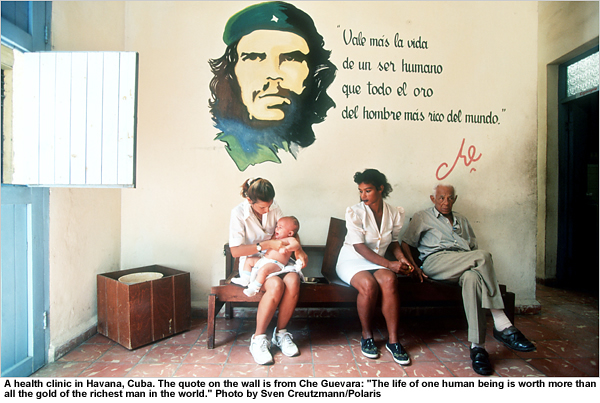 In June of 1959, the revolutionary government declared that every Cuban has a constitutional right to free and adequate state-run healthcare. This one policy would then lead the country to produce health indicators at the level of, or better than, those of developed countries, like the United Kingdom or the US.
Due to the emphasis on preventative, centrally-planned, state-run healthcare services, the country experienced two major setbacks on their journey to healthcare equity. Nearly half of all doctors moved abroad, and the country faced economic sanctions from the US, which, during the Batista era, was deeply entrenched in the Cuban economy. This retaliation would strain the supply of medical practitioners and cut off the supply of trade-related pharmaceuticals.
These setbacks only revealed the resilience of socialism, and counter the belief held by many liberal economists that socialism leaves no incentive for innovation. The Cuban healthcare system was developed out of necessity – the need to provide everyone with a good life despite the challenges it may confront.
The first intervention that marked a transformation was the establishment of the Committee for the Defence of the Revolution, which initially was tasked to defend against external threats by patrolling at night to protect against sabotage and counterrevolutionary behaviour. They were then integrated into alternative operations, primarily healthcare, and this kicked off the start of the physical dismantlement of the Batista regime’s atrocious healthcare system.
Medical training advanced as the Cubans requested assistance from organisations such as the World Health Organisation and the Pan American Health Organisation. They provided support from technical experts and fellowship programmes that enhanced the training of healthcare personnel.
The success of these interventions allowed Cuba to open their very own medical school, the Latin American School of Medicine (ELAM), which educates locals and foreigners – you might have heard of the South Africa-Cuba exchange programme, where South African students are trained to become doctors in Cuba. Rural area deployments were also made obligatory on graduates, which meant that the rural area was never left behind.
These developments allowed the government to, from 1976, shift its focus from a hospital-focused framework to primary care with community medicine. The system centred itself around family doctor-and-nurse or community health workers who visit each household twice per year.
By the late 1990s, some 31,000 teams were responsible for 120 to 160 families or 500 to 600 patients. These teams entirely re-aligned priorities. More medical staff meant better disease reporting, a greater budget allocation meant better facilities, and in general, the country made the move towards preventing illnesses, instead of predominantly concentrating on cures. Immunisation was a focus area of this new system.
Successes of the new system:
- Infant mortality stood at 4 per 1000 live births in 2018
- Life expectancy was 79 years of age by the 2010s
- A huge reduction in infectious diseases
- 98% of births took place in hospitals.
We also draw attention to the internationalism of the Cuban healthcare system, which is evident in its remarkable deployment of medical staff and practitioners around the world.
More than 50,000 Cuban medical professionals are working in 67 different countries! Examples include the earthquake in Haiti (2010), the US in the aftermath of hurricane Katrina (2005) and in the earthquake in Pakistan. Additionally, the deployment of doctors across the world to combat Covid-19 – they are assisting in South African hospitals and clinics to this day.
The Cuban healthcare system stands as a testament to resilience, innovation, and the pursuit of equity in the face of formidable challenges. Born from revolution, shaped by necessity, and sustained through global solidarity, it has transformed Cuba into a model of preventative, community-based healthcare.
Its achievements at home and its internationalist contributions abroad reflect not only the success of socialist planning but also a profound commitment to human dignity and well-being.
Cde Exlira Giose-Davids is a National Committee member of the YCLSA
Umsebenzi Online is an online voice of the South African working class
ISSUED BY THE SOUTH AFRICAN COMMUNIST PARTY | SACP
EST. 1921 AS THE COMMUNIST PARTY OF SOUTH AFRICA | CPSA
Mbulelo Mandlana, Head of Media, Communications and Information
+27(0) 76 316 9816
FOR MEDIA LIAISON & CIRCULATION SERVICES
Hlengiwe Nkonyane
Communications Officer:
Media Liaison, Social & Multi-Media Digital Platforms Co-ordinator
Mobile: +27 (0) 79 384 6550
OFFICE, WEBSITE, SOCIAL & MULTI-MEDIA DIGITAL PLATFORMS
Office: +27 (0) 11 339 3621/2
Website: www.sacp.org.za
Twitter: SACP1921
Facebook Page: South African Communist Party


