


|
July-August 2020 |
|
|
|
Statement on Cde John Nkadimeng’s death |
SACP |
John Nkadimeng: A veteran of all Alliance partners passes on
The SACP released this statement immediately after Cde Nkadimeng died. A fully tribute will be carried in the next issue of Umsebenzi
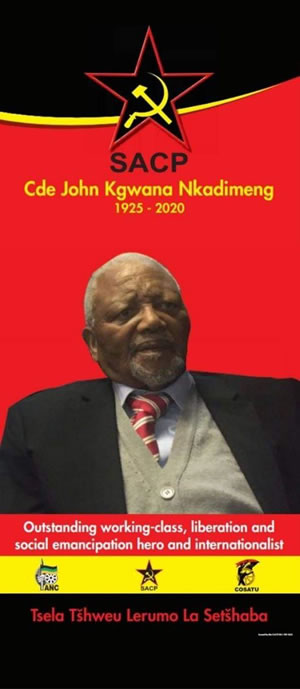
The SACP conveys its sincere condolences to the family of Comrade John Nkadimeng as well as to the working class and our national liberation and progressive trade union movement for the great loss encountered with the death of Cde John Nkadimeng.
Ntate Nkadimeng passed away in Johannesburg on Thursday morning, 6 August 2020. He was born in 1925.
South Africa has been deprived of a selfless hero and will be poorer without Cde Nkadimeng and his invaluable contribution. Our heartfelt condolences also go to the people of South Africa as a whole.
In memory of this fine revolutionary, the SACP calls upon the working-class and the progressive trade movement to unite and fight corruption to the finish.
It is through maximum unity and revolutionary discipline that the working class and its allies will also overcome the coronavirus pandemic, in memory of the frontline workers who passed away saving others’ lives and those who remain dedicated in the service to the people.
It is through maximum unity and revolutionary discipline that the working class will advance successful struggles to overcome the chronic crisis that the Covid-19 pandemic is deepening – the high levels of inequality, unemployment, poverty and unequal development.
And it is through maximum unity and revolutionary discipline that the working class will uproot racism and patriarchy and bring gender-based violence to an end.
The success of our country’s democratic transition also lies in a victory against state capture, old and new, including covidpreneurs, and in a victory against other forms of corruption and looting.
The SACP will deepen its programme to build a popular Left front, and the widest possible patriotic front, to tackle neoliberalism and the threat of the imperialist forces that seek to use the sphere of finance and other weak links in our post-apartheid dispensation to usurp our democratic national sovereignty.
The working class must triumph. This will be the best way to secure and deepen Ntate Nkadimeng’s revolutionary legacy.
Cde Nkadimeng served as a member of the SACP Interim Leadership that spearheaded the establishment of the Party’s structures following our hard-won unbanning in 1990. Before then, he served as a member of the SACP Central Committee when the Party operated in exile and in the underground in South Africa, buttressing mass mobilisation to dismantle the apartheid regime.
Comrade Nkadimeng was a trade unionist of note. He fought for workers’ rights and universal emancipation. He served as an organiser of the Council of Non-European Trade Unions in the former Transvaal. During the 1950s, he became part of the South African Congress of Trade Unions’ (SACTU’s) leadership.
SACTU formed part of the Congress Alliance that organised the Congress of the People in 1955, with the SACP active in the underground and openly through its undisclosed members and leaders in the Congress Alliance formations.
In the years leading up to the Congress of the People, Comrade Nkadimeng took part in the 1952 Defiance Campaign. A year after the Congress of the People adopted the Freedom Charter, he and 155 other stalwarts of the South African liberation struggle were charged with treason.
Despite the harassment by the apartheid regime, including the arrests that he faced, Comrade Nkadimeng continued with the struggle to overthrow the apartheid regime.
Cde Flag Boshielo, a communist stalwart, member and commander of uMkhonto weSizwe (MK) who motivated Comrade John Nkadimeng to join the ANC in 1950, disappeared in 1972 on his way to South Africa, from Zambia. The details of Comrade Boshielo’s disappearance are still unknown and require a thorough investigation in honour of Ntate Nkadimeng, his great friend and comrade.
The stalwarts of our struggle for liberation and social emancipation were constantly targeted and harassed by the apartheid regime. In 1964, Cde Nkadimeng experienced one of his numerous arrests. He was sentenced to imprisonment and released in 1966 with banning orders and restrictions imposed on him. He finally left the country in 1976 after the heroic 16th June youth uprisings against apartheid.
Cde Nkadimeng ascended to the responsibility of SACTU’s General Secretary in 1983 and was involved in the process that led to the formation of Cosatu. Throughout his activism, he laboured selflessly for the unity of organised workers and the unionisation of unorganised workers.
At its 11th National Congress held in 2002, the SACP conferred upon Ntate Nkadimeng, an internationalist of note, the Moses Kotane Award for outstanding service to the Communist Party and the working class.
In 2018, the government conferred on the prominent leader the Order of Luthuli in Gold for ‘Dedicating his entire adult life to the struggle for liberation, workers’ rights and for the formation of a united federation of trade unions’.
The ANC bestowed its highest honour of Isithwalandwe/Seaparankwe to the veteran of the South African struggle in 2019.
SACP dips our Banner in Honour of Stalwart of our Revolution, Andrew Mlangeni
(6 June 1925 - 21 July 2020)
Jenny Schreiner
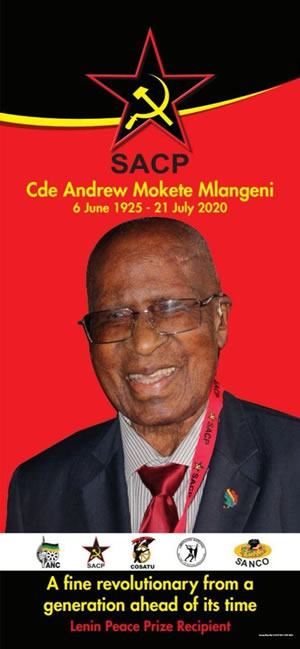
On 21 July 2020 we dipped our banner for Isitwalandwe Comrade Andrew Mokete Mlangeni and vowed to take up his spear and fight for the full realisation of the freedom he committed his life to. Comrade Mlangeni had recently celebrated his 95th birthday, having been born, with his twin sister Emma, on a farm north of the town in the district of Bethlehem in the Free State on 6 June 1925. The family’s stay on the farm came to an abrupt halt when his father, Matia, died when Cde Mlangeni was six, as being a labour tenant family, when the worker in the family died, the right to live on the farm ended.
At the age of 10, he lived with an older brother in the location outside of Bethlehem, and then aged 12 moved to another brother’s house in Kroonstad where he started his formal education. His father had compensated for the lack of schools for black children in Bethlehem area by teaching his sons to read and write. At the age of 15, he moved again to live with a brother living in Pimville, Soweto.
It was during this time that he started to work after school as a caddy at the Johannesburg Country Club to assist his mother, Aletta, put food on the family table - the origin no doubt of his later passion for the game of golf! His elder brother assisted in paying his school fees, enabling Cde Mlangeni to get his Junior Certificate from St Peters Secondary School in 1946. During this time, he also became involved in local politics, joining the Pimville Youth Organisation. Cde Mlangeni had already been recruited into the Young Communist League by Cde Ruth First in 1944, and he worked as a journalist on the newspaper New Age when Ruth First was editor.
Faced with the state policy of banishing of political activists to “where they came from” after the National Party came to power in 1948, Cde Mlangeni chose his official birthplace as Prospect township, which was demolished as a non-racial slum in 1938 – meaning he could not be sent back to where he had come from – he could remain in Soweto no matter what action the state wished to impose on him.
Cde Mlangeni married June Ledwaba in 1950. Their first child, a daughter called Maureen, had been born in 1949. Their family grew with a second child, Sylvia, born in 1950, a boy named after Mlangeni’s father, Matia, but also known as Aubrey, born in 1953 and the last-born son, Sello, arriving in 1956.
Cde Mlangeni’s political activism also took him into the ANC YL in 1951, then into the ANC in 1954, becoming Branch Secretary of the Dube branch, and representing his branch in the Congress of the People in Kliptown on 26 June 1955, where the Freedom Charter was debated and adopted clause by clause.
During the early 1950s, Cde Mlangeni worked for an engineering company that owned one of the first duplicating machines in the country, which over the weekends he used to print ANC leaflets. He was fired after 10 years for doing something he described as “very stupid” and then began working as a bus driver (his driving skills were put to good use in his later revolutionary duties), and became active in the Putco strike for a living wage and better working conditions.
It was this same year of 1955 that Cde Mlangeni was recruited into the underground and resuscitated Communist Party, the SACP, serving full time as its secretary for the Johannesburg district in 1959.
In the establishing of Umkhonto we Sizwe, Cde Mlangeni was the first to be recruited into MK by Cde Mandela. It is said that Cde Mandela took Cde Mlangeni to a “safe house” in Johannesburg and asked him to do push-ups so he could see how fit he was. In 1961, Cde Joe Slovo recruited him along with 5 others including Cdes Nandha Naidoo, Raymond Mhlaba, Joe Gqabi and Patrick Mthembu to go to China for military training, instructing him not to tell his wife – an instruction he disregarded.
He travelled with Raymond Mhlaba in a circuitous route through Africa, Prague, Moscow and Irkutsk before arriving in the far north of China. After an initial induction as a group, Mlangeni, known as Percy Mokoena during this year-long training programme, and Naidoo travelled to Shenyang (Mukden) to be taught radio technology and communication. During this year, Cde Mlangeni met Mao Tse Tung who visited the camp, a story oft told in his reflections of his life.
Percy Mokoena returned home, to become Andrew Mlangeni again, soon taking over from Cde Joe Modise in recruiting volunteers and transporting them to go for military training in Africa. Conditions of illegality and the nature of his mission, required him to pose as Rev. Mokete Mokoena, wearing clerical clothing. On one fateful night in the winter of 1963, Cde Mlangeni, due to pick up recruits from Krugersdorp the next morning, exhausted by the work that he was performing, slept over at his own home instead of his safe house, only to be arrested in the early hours of the morning.
And so began his 26-year incarceration. He was charged with trying to get recruits, including a then 22-year-old Jacob Zuma, out of the country from Zeerust, but since he had in fact not been in Zeerust at the time, he was acquitted - only to be arrested and charged along with the other Rivonia trialists, who had been arrested at Liliesleaf Farm on 11 July 1963.
Although not in the High Command, Cde Mlangeni was charged with sabotage and conspiracy, facing a maximum penalty of death by hanging in found guilty. He faced evidence in court from one of the comrades he had trained with in the year in China in 1962, Patrick Mthembu, who had been arrested for a second time, tortured and turned state witness. Before the court passed judgment on him, Cde Mlangeni, constant as he was in his political posture throughout his life, told the court that:
“Though leaders of many countries throughout the world have tried to persuade the Government to abandon its apartheid policy, and although resolutions have been passed in the United Nations against South Africa, this has met with no result. All that the Government has done is to reply to the people's demands by putting their political leaders in gaol, and breaking up families"
Eight of the Rivonia trialists, including Cde Andrew Mlangeni, were sentenced to life imprisonment on 12 June 1964. He and the other black Rivonia trialists served their sentences on Robben Island with Cde Mlangeni getting the prison number 467/64 and the cell next to Cde Mandela.
In 1982 after political prisoners had returned from the quarry on Robben Island and had their night meal, the metal doors opened and they were told to pack. Hoping that they were to be moved to prisons closer to their families, they instead found themselves after a boat and bus trip, arriving in Pollsmoor. Cde Mlangeni describes how compared with Robben Island, Polsmoor was a “five star hotel”: for the first time they had fresh water, not the brackish water of the Island, and fresh bread.
Twenty-two years later, in 1986, Cde Mlangeni and his fellow political prisoners rejected an offer Cde Mandela had brokered that they should be released. They had welcomed Cde Mandela back to Polsmoor prison from a stint in hospital where he had been treated for TB, and he informed them that he had been approached by National Party Minister of Justice, Kobie Coetzee, with an offer for the release of the Rivonia Trialists on the condition that Mandela would not be released at the same time to avoid the expected mass response from the people of South Africa. It was Cde Mlangeni who responded, saying that they had been sentenced together, to the same sentence, and they would be released together – they instructed Cde Mandela to reject the offer. Such was the nature of the collective of leadership of that Rivonia generation
In 1989, three years after rejecting that first offer of release, a new agreement was brokered that freed Cde Mlangeni and fellow trialists, together with the PAC’s Cde Jephta Masemola and trade unionist Cde Oscar Mpetha (Cde Denis Goldberg and Cde Govan Mbeki had been released earlier) with certainty that Cde Mandela would be released within a few months.
Cde Mlangeni’s family had kept vigil for three nights, having been told that the release was imminent. Exhausted, they fell asleep and in the early morning they were woken by the clattering on the roof. Cde Mlangeni had arrived, and he had thrown a stone on the roof to wake them! His daughter Sylvia emerged, and called to the family to wake up and welcome this free man home. Cde Mlangeni said that “I don’t know if I will ever be able to describe the feeling,” on that morning.
Just a few weeks before he was released in 1986, Cde Mlangeni’s twin sister died. Cde Mlangeni acknowledged that his sister’s death was devastating: “I cried more than I had cried for all the other deaths. I felt like a part of me had been taken away, that my other half had died and that I was no longer myself.” In Sotho culture it is important for a surviving twin to be at the graveside. He applied to go to the funeral. The apartheid state refused permission.
From the time of his sentencing in 1964 until his release in 1989, Cde Mlangeni received the steadfast support of his wife June, who became a pillar of strength to families of other detainees and political prisoners, particularly in the Detainees Parents Support Committees of the 1980s. Cde June Mlangeni died from cancer in 2001, a massive emotional blow, shortly after the 50th anniversary of their marriage,
Cde Andrew Mlangeni was a recipient of the International Lenin Peace Prize, awarded by a panel appointed by the Soviet government, to notable individuals whom the panel indicated had "strengthened peace among comrades". It was renamed the International Lenin Prize for Strengthening Peace Among Peoples In 1992. The ANC awarded Cde Mlangeni the Isithwalandwe Seaparankwe, the highest honour recognising those who have made an outstanding contribution to the liberation struggle. He received the Presidential Order for Meritorious Service: Class 1: Gold from former President Mandela in 1999.
Cde Mlangeni was elected to serve as a Member of Parliament from 1994 to 2004, and, again, from 2009 until 2014, when he retired.
On 26 April 2018, Cde Mlangeni received an Honorary Doctorate in Education from the Durban University of Technology and an honorary doctorate in Law on 7 April 2018 fr0m Rhodes University.
Cde Mlangeni was awarded the Freedom of the City of London on 20 July 2018 at age 93, and during this visit, he was also a guest of honour at the opening of the Mandela Centenary Exhibition at the South Bank Centre. On the Centenary Celebration of Cde Nelson Mandela's birth, he also read Cde Mandela's favourite poem, Invictus, which was aired on the BBCs Newsnight programme
His new struggle was against corruption. He identified it as the main war we are faced with. Known for his ethical discipline, he was appointed to Chair the ANC Integrity Commission and in 2016, called then President Jacob Zuma to a meeting in which the Integrity Committee appealed to Cde Zuma to step down. Cde Mlangeni stated that “We did not want to publicly condemn him. We said let’s take a different approach.” So, having recognised Jacob Zuma’s contribution over the years, he explained that things had completely changed, and appealed that Zuma should quietly step down.
The SACP has recognised that “Cde Mlangeni was fiercely opposed to corruption and corporate capture of the state. In memory of the gallant fighter of our struggle, the SACP will deepen its efforts to build patriotic and popular left fronts to combat corruption in defence of our democracy, and in pursuit of the national imperative of structural transformation and inclusive development towards prosperity for all, especially the working-class and poor.”
Cde Mlangeni lived in the same modest house in Dube, where he was arrested, until his death. Cde Mlangeni who turned 95 on 6 June 2020, has not been well over the past few years, and yet in between bouts in hospital he participated actively in organisational activities. He attended the SACP 4th Special National Congress in December 2019, and jokingly said to General Secretary Blade Nzimande that he “came to check if you chaps are still focused”. He was very happy with the theme of the Party congress “Rebuild the Movement: Socialism is the future, Build it Now.”
Cde Mlangeni was admitted with an abdominal complaint to 1 Military Hospital in Tshwane, where he passed away on 21 July 2020. Cde Mlangeni is survived by his two daughters, Maureen and Sylvia and his son Sello. His other son, Aubrey, died in 1998.
Cde Mlangeni has been held is high esteem by comrades and colleagues alike. The respect he enjoyed came not from trying to be popular, but from trying to do the right thing when the times demanded it. In tough times, when factionalism and corruption have bedevilled his beloved ANC and have tested the Alliance, Cde Mlangeni remained that pillar of discipline and integrity that is expected of a tried and tested cadre, and he remained the personification of ethical comradeship, with that twinkle in his eye and smile on his lips that made all who knew him love and respect him so dearly.
Hambe Khahle Qawe lamaqawe!
Cde Schreiner is an SACP Central Committee and Politburo member and former MP, Director General, MK combatant and political prisoner
Learning from the Past, Active in the Present, Building the Future, Building Socialism Now
Blade Nzimande
This is an edited and briefly shortened version of the General Secretary’s input at the 2 August virtual rally
Learning from the Past, the Roots of the Communist Party
This week marked the 99th anniversary of the founding of the Communist Party. We celebrate this historic occasion, the founding of the oldest Communist Party in Africa, under the theme Learning from the Past, Active in the Present, Building the Future, Building Socialism Now.
On 29 July 1921, communist militants announced the formation of the Communist Party at a public meeting in Cape Town. The founding Congress of the Communist Party officially opened the following day, on 30 July 1921, at 20 Plein Street in Cape Town. It was on that day that the resolution formally establishing the Communist Party was passed. The Congress was held over three days until 1 August 1921.
However, the formative process of the Communist Party dated back to 1914, and the outbreak of the inter-imperialist First World War
Opposition to the inter-imperialist First World War (what Lenin at the time described as a war of thieves for control over the world) came from revolutionary wings of existing mass socialist parties in many parts of the world. Here in South Africa, revolutionary progressives in the South African Labour Party broke with that party, in opposition to its reformist, sell-out position of joining the war in defence of the British Empire. In the name of working-class internationalism against imperialism comrades like David Ivon Jones, Bill Andrews and S.P. Bunting established the International Socialist League, the nucleus of what would soon become the Communist Party in South Africa.
In 1918 Cde T.W. Thibedi, a member of the International Socialist League organised the first African trade union, the Industrial Workers of Africa. The history of the Communist Party since that time in building the progressive trade union movement in our country is unparalleled. In 1918, the formation of the Industrial Workers of Africa led to the Johannesburg ‘bucket-workers’ strike. 152 workers were arrested and sentenced to two months’ imprisonment under the so-called Masters and Servants Act. Cde S.P. Bunting, five other members of the International Socialist League, and several members of the ANC, then called the South African Native National Congress, were also arrested.
The International Socialist League was the largest component when different Marxist formations and comrades came together to form the Communist Party as a unitary Marxist-Leninist formation in 1921. This step forward was inspired by the 1917 Great October Socialist Revolution and by the Communist International, formed in 1919 following the revolution in Russia.
The formation of the Communist International was an active expression of Communist Party organisation and working-class unity on a worldwide scale. This required unity of Communist Party organisations in every country. The Communist International admitted only one affiliate per country that met its basic requirements. This principle of unity was a basis on which our Party was established in 1921, championing before all others the principles of anti-imperialism, working-class internationalism and non-racialism.
For much of the 1990s and early 2000s, as the SACP insistently noted at the time, the very notion of imperialism seemed to disappear from the strategic perspectives of our ally, the ANC. Perhaps confused by the global celebrity of Cde Nelson Mandela and the apparent embrace of our democratic transition by all and sundry, there was a tendency to imagine that a new peaceful and more equal global order had emerged.
But the collapse of the Soviet bloc of countries did not mean the disappearance of imperialism. Imperialism became more arrogant, more triumphalist. This aggressive arrogance is still in evidence today, in the midst of the current coronavirus (Covid-19) pandemic, as imperialist-backed pharmaceutical companies are competing for mega-profits by cornering the market on a vaccine and treatment.
With the deepening global capitalist economic crisis, imperialism has become more aggressive, more dangerous. In the midst of what some are calling the Greater Recession following the Great Recession of 2008, and as the US’ global hegemony begins to slide, Trump is determined to make ‘America great again’. He is sabre-rattling in the South China Sea, he is threatening to unleash war on Iran, he is deploying masked federal storm-troopers onto the streets of US cities against peaceful Black Lives Matter protests, and he has withdrawn from the World Health Organisation.
This is the context in which our own National Treasury and Reserve Bank have made the grievous mistake of taking on a dollar-denominated IMF loan, exposing our economy to further suffocation by imperialist interests. In the midst of important discussions within the ANC-led Alliance on an economic response to our many challenges, it is hard not to see the behaviour of the National Treasury and the Reserve Bank as an attempt to achieve through IMF conditionalities what they cannot achieve through a democratic discussion here at home. In confronting this situation, we need to draw courage and learn lessons from our past determination and resilience in our struggle for liberation and social emancipation.
The Communist Party of South Africa (CPSA) was re-named the SACP in 1953, when we reconstituted it in underground, following the apartheid regime’s Suppression of Communism Act of 1950.
The resoluteness and resilience of the Communist Party
Throughout our 99-years, Party cadres have made a major contribution to the struggle for national liberation, national sovereignty and democracy.
A few examples:
- The Communist Party consistently exposed the connection between class exploitation of workers by capitalists, racist oppression and patriarchy.
- The Communist Party was the first political formation in South Africa to organise on non-racial lines.
- The Communist Party built progressive trade unions and our national liberation movement, also forming part of it.
- It was the Communist Party that was the first political organisation to be banned in South Africa.,
- It was the Communist Party that first advanced the struggle for one-person, one-vote.
- It was Communist Party activists, like Dora Tamana, who ran co-operatives in informal settlements in the 1940s and 1950s, and Ruth First, who advanced progressive journalism and freedom of the press.
- Ruth First was martyred. She was killed by the apartheid regime through a parcel bomb. She numbers among many, many martyrs of our struggle for liberation and social emancipation, Johannes Nkosi, Vuyisile Mini, Alpheus Maliba, Basil February, Ahmed Timol, Matthew Goniwe, Chris Hani, and many others.
The Communist Party continues to be a target of the exploiters and the corrupt. In recent years, decades after the end of white minority rule, there have still been assassinations and attempted hits on SACP activists. Most recently the SACP lost members who were killed for being vocal against the looters of the VBS Mutual Bank in Limpopo Province. Their sin was to be in the forefront of our campaign against those involved in the ‘Great Bank Heist’. The SACP has also lost anti-corruption fighters killed in Mpumalanga, KZN and other provinces. The SACP and our loyal activists on the ground will not be deterred. The looters of public resources must be rooted out and sent to jail to wear orange overalls.
Today, as we celebrate the 99th anniversary of the SACP, we dip our Red Flag in honour of all of those who have fallen. Let us pick up their fallen spears and intensify the struggle against corruption. A luta continua!
The SACP is no longer an underground organisation and cannot be stuck in the past methods of organisation. The SACP must move with the times and be innovative. Today, the SACP is larger than ever before. It has a membership of over 311 000. It is continuing to grow. However, as we state in our programme, the South African Road to Socialism, what we seek to build is a large but vanguard Party capable of setting an example of discipline, commitment and strategic capacity on all fronts of struggle. There is a big difference between such a sizeable vanguard Party and a mass party.
The SACP has grown because it has been active and attractive to an increasing number of activists.
Developing, continuing and deepening vanguard role of the Communist Party
We have grown because we have been prepared to speak up in defence of workers and poor:
- When our government introduced its misguided GEAR macro-economic policy in 1996, the SACP said we need a state-led industrial policy. We said macro-economic policy must be subordinated to and support national production development.
- When our government launched a misconceived privatisation drive in the late 1990s, the SACP said ‘Down with Privatisation’, and mobilised against it. We said we need a strong, democratic developmental state instead.
- It was the SACP that started the vitally important land and agrarian transformation campaign in the 2000s, challenging, among others, the so-called willing-seller, willing-buyer, and pushing land redistribution.
- Again, it was the SACP that started the campaign for the transformation of the financial sector, resulting in important advances for the working-class and poor.
- It was the SACP that first exposed the existence of corporate state capture in our country. Back then, implicated elements, their factional networks and hangers-on reacted by dismissing the existence of state capture.
- The SACP persisted. Again it became the first to call for a judicial commission of inquiry into state capture. This call was rejected by the same networks and in addition by almost all parliamentary parties. The former Public Protector Advocate Thuli Madonsela reached the same conclusion as the SACP, prescribing the judicial commission of inquiry into state capture following an incomplete investigation, and as part of the remedial action the Chief Justice had to identify the judge to head the commission for the President to appoint.
The struggle is not over.
Internal threat to the revolution and the liberation movement
Tenderisation of the state and the corruption that it breeds make up a great threat to the same national liberation movement that brought about democracy in our country. The movement enjoyed the revolutionary moral high ground. With the overwhelming support of the people, the liberation movement finally dislodged the apartheid regime in 1994. Today we cannot say the movement has the same level of support. The rise of corruption has eroded the support that the movement enjoyed. The material basis of corruption lies in the tenderisation of the state, which is used as an instrument to empower a few.
The SACP is warning against this self-destructive trajectory and calls on our movement to reset to its revolutionary historical mission. The movement cannot be held hostage by the interests of a greedy few. A failure to reset to the revolutionary historical mission will see a continuing decline until all power is gone.
Active in the present, building the future, advancing to socialism in the here and now
Many of the post-apartheid achievements experienced by millions of the working-class and poor are indeed under threat. We need to learn from the past, intensify our activism in the present and build the future, socialism, in the here and now. Our key priorities:
- We must strive to overcome the Covid-19 pandemic and ensure that we do not return to the chronic crisis before the crisis but we advance through a developmental path – the SACP appreciates the work done by the frontline workers in the fight against the pandemic. This requires building a democratic developmental state with an internal capacity to serve the people.
- We must intensify the struggle to end the tenderisation of the state, the corruption it breeds and tackle its associated tendencies, tenderpreneurs and their Covid-19 manifestation, the covidpreneurs. Every cent in the government’s Covid-19 expenditure must be accounted for. Those involved in fruitless and wasteful expenditure, corruption and looting, must be successfully prosecuted, and severe sentences, asset forfeiture and other forms of punishment be imposed.
- We must advance rapidly to building a National Health Insurance.
- We must push for the building the publicly owned economic sector in the interest of the people, especially the overwhelming majority, the working-class and poor. This requires state-owned enterprises to be turned around to thrive. In order for this national imperative to succeed, the SACP has to intensify its campaign against privatisation in all its disguises, including neoliberal structural reforms. Such reforms directly contradict the aim of building a capable democratic developmental state and are bent against the working-class.
- Going to the root, we need to advance structural transformation to build, diversify and raise the levels of national production. This requires a decisive drive to achieve industrialisation, transformation of the mining sector to support high-value-added manufacturing, localisation, accelerated land redistribution, agrarian transformation, and transformation of the financial sector, to name but a few programmes needed to radically reduce inequality, unemployment, poverty and unequal development. In order for this strategic aim to be realised, the SACP has to intensify the campaign including new state capture and its networks.
- The rising high levels of inequality, unemployment, poverty and the associated crisis of social reproduction make up the real and single biggest crisis in South Africa. In contradiction, according to the neoliberal recidivism of the National Treasury, the crisis is the debt to GDP ratio. To solve what it sees as a crisis, the debt to GDP ratio, the National Treasury has embarked on the dangerous path of increasing the accumulation of foreign currency denominated debt as a solution! To defend our country’s democratic national sovereignty, our fundamental right to self-determination, our hard-won democracy, the SACP rejects domestication of foreign economic agendas including the neoliberal structural reforms pushed by the IMF and its ilk.
- Let us also combat with determination gender-based violence, criminality, drug and substance abuse. These scourges are destroying our society.
A key task facing the SACP with respect to all these programmatic areas is to help to unite the working-class and build both a popular Left front against austerity and an even wider patriotic front in defence of our democracy, and our national sovereignty.
The Jobs bloodbath
The SACP is seriously concerned about the rising tide of the jobs bloodbath. Retrenchment notices in the private sector have been increasing at an alarming rate. The private sector overwhelmingly controls our economy and in many sectors there is also absolute monopoly. In the retail sector, workers at Edcon (Edgars) and Dion Wired, for example, are facing neoliberal restructuring, branch closures and job cuts.
In the metal sector, retrenchment notices have been rising. This is the case in other sections of the private sector. It is very clear, also, that there is mismanagement and bad governance in the private sector. This is highlighted by the rising number of insolvencies and liquidations. The recent statistics released by Statistics South Africa on insolvencies and liquidations are shocking. It is also very clear that capital is forcing the working-class to absorb the economic and social impact of the Covid-19 pandemic.
We strongly denounce the private sector for the jobs bloodbath. We strongly caution the state and public entities against taking their cue from the private sector. We are equally concerned about retrenchments in the public sector, including at, but not limited to, the SABC and SAA. The state has the duty to create employment and not increase unemployment.
At SAA, the rescue process seems to have finally been placed on a way forward. However, there are problems in terms of governance and top management. A new board that meets competency requirements must be appointed as a matter of urgency. This means that the board under whose auspices SAA was placed under business recue must be dissolved as a matter of urgency. The top/senior management structure and all categories and levels must be changed to reflect South Africa’s demographics based on competency. Management control must be placed in the hands of competent South Africans.
Operations must resume, as at other airlines. The state must deliver on its commitment to support the rescue and restructuring of SAA to become viable, thrive and grow. The national carrier must also offer working-class flights. This requires a whole-of-state approach, and an integrated, affordable, reliable and safe public transport system and aviation industrial strategy.
There is no other way forward for the working class but to unite from all trade unions. The SACP is calling upon organised workers to work together to advance the common interests of all workers against economic exploitation. At our Fourth Special National Congress in December 2019, we called upon the progressive trade union movement to convene a joint national summit and discuss a common response to economic exploitation and the high levels of inequality, unemployment and poverty. We are calling on unorganised workers to realise that they share common problems and a common destiny with organised workers and to join unions and fight against economic exploitation. The SACP will continue working with trade unions to unionise un-unionised workers.
International solidarity
The SACP expresses its unwavering solidarity with.
The people of Swaziland struggling for democratisation;
- The people of Western Sahara struggling for an end to occupation by Morocco;
- The people of Palestine struggling for an end to oppression and theft and occupation of their land by the apartheid regime of Israel;
- The people of Cuba in defence of their right to the fundamental right to self-determination and against US imperialist aggression;
- The people of Venezuela against imperialist machination by the US and its puppets;
- The people of Bolivia and President Evo Morales; and
- All the oppressed and exploited across the world.
Towards working more effectively together
Mike Shingange
This is a an edited and shorter version of Cosatu’s message at the SACP’s 99th Anniversary Rally
Background
COSATU is proud to share a stage with alliance partners and internationalists to celebrate this great day on which our critical ally, the South African Communist Party was born.
Since 1921 when the core of communists came together to form this vanguard of the working class, the SACP, things have never been the same in South Africa. The SACP produced great stalwarts and communists, who, by virtue of their work, status, and depth of engagement in the class struggle, earned so much confidence of the working class that came to be organised under SACTU, FOSATU and, ultimately, COSATU.
We are proud of the legendary history we have and still share with the SACP and together have constituted the left axis of the glorious tripartite alliance.
It was the SACP and the ANC who set out their duty as that of strengthening COSATU and it was COSATU that set out that strengthening the ANC and the SACP remains our guiding task.
Tribute to SACP Stalwarts and Veterans
This past week alone, we buried a great stalwart of the ANC/MK and SACP Ubaba Andrew Mlangeni and celebrated the centenary of a great stalwart, Harry Gwala. These giants of our revolution symbolised what it means to be a true example of a cadre leading society,
This happens when we are right in the middle of a COVID pandemic and a Corruption pandemic, in which thieves are running amok, stealing food parcels and all that our people need to live with.
We are proud of the history and role of such great SACP stalwarts like Ray Cdes Alexander, Jack Simons, Moses Mabhida, Moses Kotane and Chris Hani. We are always inspired by their selflessness and genuine commitment to the cause of workers and the poor.
On Organisational matters
The SACP and COSATU met in a bilateral recently and true to our comradeship, we robustly dealt with all issues we regarded as irritations between our two organisations. The maturity with which both organisations handled these very sensitive matters reflects the maturity of the relationship and the struggle we are together prosecuting.
We produced a guiding framework of the way forward:
- Joint Political Schools and cadre development programmes to strengthen the ideological clarity and capacity of our members in particular.
- Joint Campaigns and community action on issues affecting workers and communities to reinforce united class mobilisation. This is with particular reference to retrenchments.
- Joint Research and Policy Development Capacity and initiatives, particularly around the most pressing issues of the moment - energy, aviation, SOEs, economic transformation, local government service delivery, enforcement of anti-corruption systems, our education crisis and a whole lot of issues affecting workers.
- Tighter coordination between our various departments and areas of work led by the Secretariats of each organisation and jointly
Our struggle for a new and better Normal
We are fighting for a new and better normal. One free from the crisis before the crisis.
We meet during these trying times of COVID-19 to underline the bond that exists between our organisations and the working class forces we represent. COVID 19 has exposed the fault-lines of the South African economy and society.
The shocking levels of inequality, poverty and unemployment have opened a very horrifying side of our society, hunger and desperation never seen before or hidden by the false normalcy we lived under for so long.
As we commit to flatten the COVID-19 pandemic, we simultaneously seek to flatten the horrifying curves of poverty, unemployment, and inequalities.
We must save lives, jobs, and livelihoods. This is our collective mission. We are urging the alliance to strengthen its focus son dealing decisively with the ugly reality exposed by the COVID-19 on workers and communities.
In this regard, dear Comrades, we call on all our alliance partners and social forces to focus on saving the lives of the frontline workers as the backbone of our health system. Saving workers lives, saving the public health system, and strengthening the momentum towards the National Health Insurance is our decisive mission at the moment.
The struggle for PPEs, better salaries for workers, improved working conditions, health and safety standards, compliance with WHO and government regulations on the pandemic, as well as prioritising major investment in public health and personnel to deliver effective services to the people are vital.
Time for Reflection and Action
The Covid-19 inspired economic crisis is posing some very difficult questions to all the progressive forces in South Africa and around the world.
In the United States, the working class is up in arms, after discovering the so-called American Dream that has been sold to them for the decades is nothing but a farce. After the 2008 Global Economic Crisis, we saw the Occupy Movement and since then we have seen a proliferation of what would be considered progressive organisation from the Black Lives Matter (BLM), the #meetoomovement and other movements challenging the status quo. Despite this reawakening, the progressive forces are fragmented, and they are leaderless in the face of an organised onslaught by capital.
Over the last 26 years the debate around the economy has sometimes deteriorated into a verbal sparring match between nationalisation freaks and privatisation maniacs. It will help our cause as a class to use this opportunity to answer these questions:
How do we respond to these challenges without a global international working class movement?
- What is our socialist theory of an alternative world economy to challenge the free market system?
- Why have we failed to create our organs of working class power and collective forms of ownership as part of our strategy for a socialist revolution?
- Why has the working class failed to assert itself ideologically and through practical organizational and political programmes and struggles?
- Despite a range of mass formations organizing students, women, religious groups, youth, etc. which are historically part of the MDM and which are committed or sympathetic to socialism, why is the working class tailing behind the capitalist class and losing sight of its own interests?
- We said the 2008 Global Economic Crisis represented an opportunity to reimagine the future and dislodge capitalism. A decade later, what went wrong?
This moment calls for solid practical solutions. It is all very well being publicly and fashionably militant about many of these subjects, but we need to solve the problem of whether the country has the resources to do what we imagine.
Self-deception is one of the reasons we are in trouble. We need to face up to the realities of the situation. Engaging in pretentious outrage for political propaganda purposes is not enough.
Cde Shingange is the Cosatu 1st Deputy President
An Alliance Forged in struggle
Zweli Mkhize
This is an edited and shortened message from the ANC on the SACP’s 99th Anniversary
99 years ago, the Communist Party was born – a moment which would mark a turning point in the development of labour politics in South Africa and contribute to decades of change in the country’s political landscape. The ANC congratulates the SACP on achieving the landmark of 99 years being at the centre of the National Democratic Revolution as part of the ANC-led Alliance.
We have come a long way since more than two thousand of our like-minded brothers and sisters gathered in Cape Town following the inaugural conference to establish the aim and characteristics of the Communist Party of South Africa and adopting the constitution and manifesto which would create the foundation on which this revolutionary organisation would continue to build.
It was also during this period that the Communist Party began a close working relationship with the ANC, fighting together with many other progressive organisations against the common enemy that designed over a ruthless system of institutionalized national oppression and racial discrimination.
The formation of the CPSA marked a decisive turning point in the evolution of labour politics in South Africa. Up until then the organised labour movement consisted mainly of White working-class members. Throughout the 1920s the CPSA focused on organising African workers around issues of trade union rights and national liberation demands, and called for Black majority rule.
It was also during this period that the CPSA and the ANC began a close working relationship. From inception, the SACP correctly analysed the political situation in our country and resolved to mobilize the working class and built partnerships with progressive political formations to galvanize the masses of our people into a formidable force for liberation.
Over the years of its existence, the Communist Party has been a trusted ally of the African National Congress and an equal partner in the Tripartite Alliance; without which the significant victories would not have been surmountable in tortuous journey of our liberation struggle.
The Communist Party has always been an integral part of the conceptualisation and prosecution of major campaigns that has shaped our liberation struggle in response to the onslaught by the apartheid regime in an effort to annihilate our forces and frustrate our people’s aspirations for democracy and freedom.
The Communist Party has played a significant role in landmark activities that were a signal of the intensification of our struggle; such as the Defiance Campaign, the mass mobilization leading to the adoption of the Freedom Charter, the formation of Umkhonto WeSizwe, the mobilization of international solidarity and support for our struggle especially from the Socialist Countries, the re-establishment of the liberation movement after the unbanning as well as the participation in the negotiations.
In short, because of the uniqueness of this Alliance, the Communist Party has been part of all the victories of the ANC and its Alliance partners; celebrating the joys of our victories and sharing the feelings of sadness and the pain where the ANC suffered setbacks.
The best characterization of their relationship is found in the statement by President Oliver Tambo, who eloquently articulated the importance of the Alliance as follows: "Ours is not merely a paper alliance, created at conference tables and formalised through the signing of documents and representing only an agreement of leaders. Our alliance is a living organism that has grown out of struggle. We have built it out of our separate and common experiences."
The strength of the Alliance is the understanding and respect of the different histories, roles and responsibilities of each partner which are distinct.
This ensured that members of the SACP, a Marxist-Leninist party and vanguard movement of the workers were equal members of the African National Congress, a national liberation movement that mobilizes all classes, strata and sectors of society; in partnership with the Congress of South African Trade Unions which organizes workers around their working conditions. Lately we have included South African National Civic Association which focuses on civic issues involving residents. This unique relationship enabled the Communist Party to contribute to the theory of the revolution and development of many leaders we share.
As we celebrate the 99th Anniversary today, we pay a special tribute to generations of working-class leaders who have made an impact in the history of our struggle. Among them are Cdes Moses Kotane, J.B.Marks, Harry Gwala, Chris Hani, Elijah Barayi, Chris Dlamini, John Gomomo, Oscar Mpetha, Ray Simons, Moses Mabhida, Raymond Mhlaba, Govan Mbeki, Joe Slovo, Edwin Mofutsanyane, Dan Tloome, Curnick Ndlovu, Steven Dlamini, John Nkadimeng, Billy Nair, and many others who served everyone of our revolutionary organs with distinction. The combined experience and lessons from our forebears demonstrated that as Alliance partners, we are stronger when we work together. The best outcomes have been achieved from our united action.
Over the years we have supported one another. It is correct that we continue to influence one another. This approach has saved our struggle and averted serious crises that our country has faced. While the ANC and the SACP have not always seen eye to eye, our history has proven that when we work together, what we can achieve is endless. United, we brought an end to a ruthless and unjust system, we changed the trajectory of an entire country and we changed the lives of millions of our people.
Our forebears knew this to be true – many of them holding up the mast of both the SACP and ANC while leading the movement. This continues today with SACP members spearheading critical roles in government. Our two parties have a symbiotic relationship – there is no ANC without the SACP. We have distinct roles to play as we continue the path toward our National Democratic Revolution, and we can only achieve the best outcomes when we are united towards a common goal.
This has special relevance today as we face one of the greatest challenges in our recent history. It is only normal for partners to disagree on some issues, but such disagreements are not antagonistic differences. It is important to ensure that we never allow adversaries and detractors to take advantage of those differences and divide us. Such arguments between us must always be a reflection of a healthy contestation of ideas and competition of different but constructive views. After all, our leaders have also warned us about these tensions.
President Nelson Mandela, addressing an SACP congress in 1995, said about the relationship of the ANC and the SACP:
``It is a relationship that has detractors in abundance; a relationship that has its prolific obituary scribes. But it is a relationship that always disappoints these experts. Because it was tempered in struggle. It is written in the blood of many martyrs``.
We need to work together to uproot the demon of factionalism that has slowly taken root in our structures. Factionalism in the ANC means factionalism in the Communist Party. We have to work hard to rid our organizations of this demon.
Rampant corruption is threatening to tear our structures and is eroding the deep trust and confidence our people have in our movement. This have to be ruthlessly tackled by Alliance partners with the same vigour used to fight against apartheid.
We note that we celebrate this important birthday when the fault lines of poverty, hunger, joblessness have exposed our flanks. We need to close ranks as we search for solutions of how to rebuild our ailing economy and eradicate inequality. We need to unite as we transform our economy to become more inclusive and stimulate growth and eradicate squalor in rural areas and peri-urban settlements.
Only a united alliance is capable of ushering in a universal Health Care system in the form of the National Health Insurance. If ever we needed unity this is the time, more than ever before.
A year before the SACP celebrates its centenary, it is called upon once again to aid the movement in yet another fight: a common enemy which we call COVID-19. Many of our workers are fighting hard on the frontlines of the battle against this virus – some have lost their lives in this fight. We need to ensure that we provide them with the support needed to see our country through this tumultuous time. We need to demand that all resources deployed to fight the pandemic be utilized appropriately and all corruption be investigated and uprooted and consequences be meted to those involved. This is a time in which our alliance needs to be at its strongest, let us learn from one another as we draw the battle plans going forward.
The fight against COVID-19 is only the first step, however. Global healthcare inequalities which have been so boldly emphasised by the currently disproportionate ill-effects of the COVID-19 global pandemic are predicated on the history of economic orthodoxy which stacked the odds against the developmental interests of poorer nations.
We wish to pay tribute to the Cuban brigade. We commend them for their solidarity and support. We understand why there has been a call for this brigade to be nominated for the Nobel Peace Prize.
We join the World Health Organisation in calling for equity in the access of essential health commodities such as vaccines, diagnostic kits, therapeutic drugs and equipment to all nations on the basis of need not on the basis of influence.
As we commemorate Women’s Month in August, as the ANC we want to denounce any form of gender-based violence and femicide. We have a duty to love, care and protect our women and young girls. We cannot keep quite as gender violence incidents continue to increase. This is an indictment on us as men and it requires us as leaders to continue speaking out against and taking action to fight this pandemic. This is the next step we must take together to prevent similar occurrences in the future.
The country spends huge amounts of money for health care on very few people. Many health care professionals only serve a few people who have money and the rest of the public is serviced by very few professionals.
We have therefore adopted a revised policy of the National Health Plan which will see ordinary South Africans have unfettered access to national healthcare service.
The NHI is in the works and we are confident that it will come into force soon as due process and conditions are ready. This will make a qualitative difference to the lives of South Africans, most of whom are languishing in fragile and uncertain social conditions which in turn impact on their well-being and life chances
This year also marks one hundred years since the birth of Comrade Harry Gwala as well as 25 years since the passing of Comrade Joe Slovo. We ought to learn lessons from Comrade Slovo’s demeanour and the way he conducted himself in the movement. Comrade Slovo led from the front and believed that a revolution without the working class is not a revolution at all. Collective leadership was also important to Comrade Slovo – we need to embrace our alliance and its partners going forward.
Cde Zweli is an ANC NEC member, former Premier of KZN and the Minister of Health
The World Water Crisis and Covid 19
Bheki Charles Stofile and Lehlohonolo Kennedy Mahlatsi
Water is more essential to human health than anything other than air. It plays an important role in maintaining hygiene and combating the spread of COVID-19. The importance of water is fundamental, and this is particularly highlighted on reflection of ecological/biological integrity. At the funeral oration of Karl Marx, his lifelong comrade and collaborator, Engels outlined the fundamentals to Marx’s materialist outlook that human beings were material beings, part of the natural world, as well as creating their own social world within it. As material beings they had to satisfy their material needs first—eating and drinking, providing food, shelter, clothing, and the basic conditions of a healthy existence, before they pursue their higher developmental needs, necessary for the full realization of human potential.
Until the recent rise of capitalism which resulted in endless disruptions, human beings had crafted a good balance between the natural ecosystem and their own social systems. The COVID-19 pandemic and the increasing threat of even more deadly pandemics is a product of the crisis of capitalism which has destabilized ecology. COVID-19 poses a serious challenge to the populations with minimal access to medicine, water and poor nutrition, untended health problems and damaged immune systems. Water scarcity for those living in arid regions as well as periodic droughts poses an imminent threat in many regions of the world. At the same time its overabundance resulting from extreme floods and building of dams to service private farms and interests transform water into a hazardous presence rather than a bountiful one that gives life to the majority of humankind.
Globalization today represents the widespread and largely unregulated presence of market economics, based on the capitalist commitment to growth, without regard for the sustainability of the ecology upon which the markets themselves depend. The ecological criteria of sustainability, like ethical criteria of justice, are not served by markets. The recent requirements by stock exchanges for listed companies to report on their sustainability interventions and half baked, patronizing tick-box projects to deliver on the Sustainable Development Goals by a few companies are mere public relations gimmicks to sustain the very capitalist interests. Very few private companies have made meaningful, honest commitments to sustainable development.
In today’s globalized world, nothing is safe from being commercially exploited by global capital—not even resources that are vital for the survival of humanity, as well as sustaining life and the ecosystem. The world’s fresh water supply is a mere 2.5 percent of the earth’s total water volume. These finite freshwater resources are today being polluted, diverted, and depleted at accelerating rates, creating a growing number of water-stressed regions. Under neoliberal circumstances, where the economy controls and rules over the ecology, some corporate owners gain giant profits, whereas everybody else endures difficulties—life-threatening difficulties, that is.
In this situation of mounting demands, water loses all its figurative and sacred meanings and is converted into a commodity, a product, a tradable good. Neoliberalism turns nature from common resource to profit-gaining commodity. In this perspective, nature is perceived as external to humans and full of usable material goods for consumption and gain. Certainly, there is a link between environmental degradation and social injustice: how people treat nature and how they treat each other is dialectically connected.
The South African Constitution is one of the few legal instruments throughout the world which recognizes the right to water. On 28 July 2010, the UN General Assembly in a historic decision recognized the right to water and sanitation as a human right. This is a fitting recognition of the crucial importance of water to the survival of individuals and the basis for development of nations and indeed the world. Water is a key driver of agrarian production. Water scarcity can cut production and adversely impact on food security. However, the continued increase in demand for water by non-agricultural uses, such as urban and industrial uses and greater concerns for environmental quality have put irrigation water demand under greater scrutiny.
The failure of capitalism to implement the necessary cuts in carbon dioxide can be explained by the threat that this poses to its very existence as a system of capital accumulation. The epochal crisis of economy and ecology within the capitalist system will continue as long as the logic of capital prevails. This conflict between economic and ecological objectives is a contradiction of the crisis-ridden capitalist system itself.
Climate change, ultimately, is rooted in the unfairness, both ecological and social, of the Western footprint of consumption. Climate change also actively fosters the need for global injustice because it affects populations differentially, and it is the poorest which are the most vulnerable and therefore the first affected by climate change damage. Climate change may affect agriculture and food security by altering the spatial and temporary distribution of rainfall, and the availability of water, land and biodiversity. The impact of climate change on global food production might be small but geographically very unevenly distributed, with losses felt mostly in sub-humid tropics in Africa, particularly in poor countries with low capacity for adaptation.
Millions of people live in countries that cannot provide clean water (or health care or education) to their citizens as they are burdened by their debt to the World Bank and the International Monetary Fund. As a result, poor countries are forced to exploit both their people and their resources, like water, to pay their debts. There are a variety of other reasons for the shortage of water. These include interference of industrial society on weather patterns, water demand outpacing supply, asymmetrical per capita consumption rates along with underfunded, inefficient, and unethical water distribution systems. Each of these reasons contributes to the problem of a shortage of water. The problem is that many of the crucial sources for the streams of energy and materials that feed human society and production are declining. Renewable sources of energy, including cultivable land, water, forests, and the world’s species, are all being exploited at rates that raise questions about sustainability
In an unequal society water should be tackled as a class issue. Its distribution has never been equitable. Residents of the informal settlements and shanty towns across the planet deal with a water crisis daily. They have little access to clean piped water and dignified sanitation systems. They have to fetch water from a far and have to rely upon open fields to relieve themselves. What has already afflicted the very poorest on the planet has now become a grave peril as it inflicts itself upon a major city.
The water crisis in areas like Qwaqwa in the Free State and elsewhere in the country confirms the persistence of the apartheid era spatial infrastructure that promoted the development of one section of the community and the underdevelopment of the other section of the community, primarily poor working class areas. For example, the existence of the Sterkfontein Dam whose primary purpose was to facilitate transfer of water to the Gauteng area without regards to the basic need of water resources by the people of Qwaqwa and surrounding areas bears testimony to this. The manner in which overall infrastructure is rolled out also appears to favour and prioritise town and business areas over the residential areas of the majority of the population, the working class and the poor.
Whenever there was a water crisis in Qwaqwa, the use of water tankers provided immediate temporary relief to the struggling communities - though at times inconsistently. There has been a large number of water storage tanks that have been installed in Qwaqwa, the Free State and large parts of South Africa. This intervention to address the immediate crisis to a systemic problem is received with mixed feelings. Of course, it is appreciated for ensuring that those who currently have no clean water are given a temporary reprieve particularly to also save themselves against the deadly COVID-19. It must however be noted that reliance on the use of water tankers has since proven to be completely unsustainable.
In some cases, the crisis was creation of the most corrupt network of tendepreneurs to loot the resources of the state unchecked. The SACP in the Free State has observed that these unsustainable quick cash intervention mechanisms could fuel the further exploitation of the water crisis situation and suffering of the communities to the continued financial benefit of the unscrupulous elements in the municipality. It is for this reason that the provision of tap water (“metsi-pompong”) should be accelerated as the lasting solution that must take us far beyond the temporary battle against COVID-19. In defining the Triple H (Housing. Health and Hunger) campaign, it is crucial that access to clean water is at the centre of this struggle.
Cde Stofile is the SACP Free State Provincial Secretary and Dr Lehlohonolo Kennedy Mahlatsi us a Free State PEC Member
On Revolution as a Process
Thebogo Phadu
Malema’s EFF has a picture in mind of a revolution being an event, not a process. The explanation is in the term itself: revolution - a radical change of society, in all its aspects. This requires a process which is impossible to put a date to it.
A true revolution has no date, and dates like 27 April 1994 are not the beginning or end of revolution. They only capture significant revolutionary moments (“democratic breakthrough” as we say), tilting the scale in the balance of forces in favour of revolutionary forces.
And dates are also important in determining the origins or beginnings of a revolution - for example the fact that the ANC adopted our struggle as national democratic democratic revolution (NDR) in Morogoro (after the SACP did previously) does not mean that for ANC, 1969 was the beginning of the NDR
This scientific approach is very much what keeps the Cuban revolution going – comrades there don’t think of revolution as being 1958/59 when Batista was ousted. But as something that is on-going to this day.
Everywhere Cuban comrades often talk about the revolutionary process in Cuba. A process that is dynamic and contradictory at times, but always bringing more radical changes for more socialism in Cuba.
As such a revolution is not a smooth process, but real struggle and we will always experience backwards and forwards, and this is because revolution always confronts it’s opposite - counter-revolution - resistance to the demands and programmes guiding such a revolution. Such resistance is primary external to our movement of progressive forces but it can also be reinforced internally within our movement .
But in my experience I find this notion of revolution being an event very strong even within our movement (not just outside) with dangerous implications. For example, the notion of ”we have arrived has to do with the distorted ( and also corrupt) notion of a revolution as well a resistance to radical transformative measures by some in our movement. This is to be expected in any real struggle anywhere in the world.
Finally, we must guard against loose use of terms like revolution - which recently has been used by the bourgeois media to confuse people - “the Orange Revolution”, “ping-pong Revolution” and the like to confuse revolution with major events or popular revolts of whatever kind that at times do have a mass base and are directed at removing a government.
As Marxists , we need to be far more analytical and precise than the EFF is.
Cde Phadu is PEC member of the SACP in Gauteng
Racism and capitalism are conjoined twins
Mandlakhe J. Radebe
The callous murder of George Floyd in broad daylight by Minneapolis police on 25 May has not only led to unprecedented levels of anger and unity across racial lines under the banner Black Lives Matter (BLM), but has discovered an interesting parallel in South Africa, Collins Khosa.
Khosa, a resident of Alexandra township, Johannesburg, died on 10 April after he was brutally assaulted by members of the South African National Defence Force (SANDF) and Johannesburg Metro Police Department (JMPD) for allegedly breaking the Covid-19 lockdown regulations. Khosa is one of the many victims of the brutality meted out by law enforcement officers who are largely black themselves. The victims of this brutality are disproportionately working class and black. Although this case was extensively covered in South Africa, eliciting rage at the viciousness of law enforcement officers, it never received the level of attention the Floyd case did.
Floyd, an unarmed African American man, died after a white Minneapolis police officer used his knee to pin his neck to the ground for several minutes, over eight long minutes to be precise, until he uttered his last dying words, “I can't breathe”. In the digital age, such acts of racism are easily captured on videos. Floyd’s case is no exception. Many racists here in South Africa have been equally exposed, caught with their pants down. Floyd’s case is yet another addition to a string of unarmed black men to be martyred by the US police. The list is just too long!
Both the Khosa and Floyd cases are tragic, but at face value it is easy see why they are dissimilar. But alas, our commercial media, like the social media, have been awash with ‘analysis’ that seeks to compare the two disparate cases. For example, broadcaster Thulasizwe Simelane evokes a well-known and emotive apartheid line: “He slipped in the shower and died” , commonly employed by the racist apartheid police official to justify their murderous orgies against anti-apartheid activists.
This line of argument seeks to juxtapose the treatment of black people by the South African and the US states as Simelane postulates, “We can’t breathe here either! Poor black South Africans are under the crushing knee and full weight of a state machinery that, sadly, can now legitimately be compared with their counterparts’ in the US, for their penchant for killing black people.” Even more worrying is the subtle undertone that essentially draws parallels between the democratic South African state and an illegitimate racist regime of apartheid, a political and social system declared a crime against humanity by the United Nations.
South Africa’s socio-economic landscape and its adverse impact on the African majority is well documented. However, attempts to equate the current suffering of the African people to either apartheid or the US systemic oppression of black people is either a case of gross ignorance or obfuscation. In fact, this stance seeks to deflect us from dealing with the real issue at hand, structural racism and its concomitant effects that have been visited upon African people for centuries. Also, it ignores the reality that police brutality is a global phenomenon whose victims are largely the working class. For example, South Africa and the US rank 20 and 26 respectively in the list of deaths caused by law enforcement officers, with Venzuela leading the pack. Of course, this should not mask police excesses in these countries but rather a reference point to the global nature of police brutality.
Realistically, it is silly to conflate the Khosa and Floyd cases as they occurred in two distinct contexts. What makes them common though is the excessive force by law enforcement officers, which must be condemned wherever it occurs. Therefore, it is important for South Africans, just like their global counterparts, to rally behind the BLM movement without feeling guilty because some low life officers are also killing black people here too. Both cases are important, but the international profile of the Floyd’s case helps to shine the spotlight on structural and systemic global racism, and it must be used as a rallying point to mobilise progressive forces.
Racism, capitalism, and the emergence of a non-racial global movement
Racism is informed by narrow beliefs that people of different races are different from each other with distinct characteristics, abilities etc, and that some are superior while others are inferior. In its 1967 “Statement on race and racial prejudice” UNESCO defined racism as “arranging groups hierarchically in terms of psychological and cultural characteristics that are immutable and innate”. Erik van Ree (2018) posits that “ Department of European Studies, University of Amsterdam, Amsterdam, The Netherlands
But the problem of racism cannot be fully understood outside of capitalism. American author, Ibram X Kendi argues that these two phenomena are “conjoined twins” whose origins cannot be defined in isolation. The starting point is the unity of oppressed and marginalised black people in solidarity with many progressive forces, including European formations that have taken to the streets in the aftermath of Floyd’s murder. In this regard, racism must be located it the historical and economic circumstances under which capitalism developed.
Capitalism is the locomotive that powers Western racism. It is the engine upon which all forms of oppression and discrimination are founded and rewarded. It is difficult to comprehend racism outside of the anti-capitalist struggles. The history of capitalism and its oppressive tendencies are synonymous with the oppression of black people either through slavery, colonialism and apartheid in our unique South African experience. Race is at the core of the organising principle of capitalism manifested through inter alia the hierarchy of the international division of labour.
Infusing class analysis in this debate enables us to appreciate that the oppression of Africans either through slavery, colonialism and any other form of oppression are all fundamentally anchored on capitalistic accumulation. There is hardly a case of oppression that can be located and understood outside of accumulation. For instance, the material wealth that our white compatriots enjoy today, manifested through racialised inequality, are a direct result of institutionalised racism with roots in centuries of slavery, colonialism and many other forms of segregation. This white privilege is entrenched in our society today.
Inserting Marxist critique into the struggle against racism should not suggest class reductionist and colour-blind politics in the context of unabating racism. On the contrary, this approach helps us reconnect with the historical perspective of our movement in confronting the vilest form of racism, apartheid. Through its struggle, premised on the national democratic revolution (NDR), our movement contributed immensely in confronting racism. Today we can invoke numerous theories such as racial capitalism and colonialism of a special type (CST) amongst others to respond to challenges of race domination.
The success of our struggle against apartheid is partly due to its non-racial character. This is a positive emerging in the Floyd case which has spread to all corners of the world. However, for this movement to flourish, it cannot be just about the BLM – important as this cause may be. It must be anti-capitalist – to confront the structure that gives life to racism. This is where the analysts who have found sudden voice on social justice faulter. Every concern about the brutality meted out again black people must be welcomed, the real injustice in our society lies in the capitalist economic structure. Our anger should be stretched to include neoliberalism and monopoly capitalism.
To do so, our efforts cannot afford to be spontaneous actions fuelled by anger and hate, every time a racist incident occurs, but coordinated anti-capitalist. Understood in this manner, our struggle against racism will also sustain its non-racial character that will liberate the victims and perpetrators alike. Anything less will be akin to looking for a needle in a haystack.
Cde Radebe is the deputy chairperson of the SACP in Gauteng Province and member of the ANC Sonia Bunting Branch
Endnotes
Thulasizwe Simelane: Collins Khosa: ‘He slipped in the shower and died’ https://www.news24.com/citypress/voices/collins-khosa-he-slipped-in-the-shower-and-died-20200606
UN Human Rights report on Venezuela urges immediate measures to halt and remedy grave rights violations https://www.ohchr.org/EN/NewsEvents/Pages/DisplayNews.aspx?NewsID=24788&LangID=E
See Erik van Ree Department of European Studies, University of Amsterdam, Amsterdam, The Netherlands
See How to be an antiracist: Ibram X. Kendi on Why we need to fight racism the way we fight cancer https://www.democracynow.org/2019/8/13/ibram_x_kendi_class_race_capitalism
The Taxi Industry: Vital to our Transport
Pule Malefane
Marx posits a vision of socialism in which mass-produced items are priced via computation of embodies labour-time with remuneration such that one hour of actual labour is exchanged for items produced in one hour. But implementing Marx’s approach today would be nearly impossible given the state of our economy, and flawed policy direction and imperatives our government is pursuing. Currently the taxi industry is one of the areas where our approach has made it difficult to view it positively and within the broader National Democratic Revolution. Instead it has been projected as disruptive, violence-prone, thuggish and non-tax paying, loathed much of the time by all. As pushing beyond capitalism remains vital, there is a need to have a paradigm shift and mind-set to craft newer models of socialising our planning and radical economic transformation to counter the skewed unprogressive capitalistic approach and the pseudo market socialism.
Our attitude towards the taxi industry needs serious overhaul given that the taxi industry is the only transport system that connects cities to townships and from industries to rural communities and is homegrown. More than 40-million South Africans use a taxi for work or recreational purposes. It is a transport mode that if properly supported and regulated, can generate over R50-billion into the national fiscus. Yet it is still ignored and treated as a step child of our transportation system. This is the industry that enjoys an unchallengeable positioning among the working class and the poor due to the following;
- It overrides apartheid spatial settlement and integrates townships and rural areas with cities and other urban areas;
- It moves more people than all other (highly subsidised and state owned) public transport systems combined – SAA (100% state owned), Metrorail (100% state owned), Gautrain and BRTs (with less than 75 000 ridership daily);
- No special infrastructure is required for taxis: they use the existing infrastructure to an extent that they can even be accessible to areas with poor road infrastructure such as Nongoma, Ga-Moletji and others; and
- It is the only transport system moving ordinary people on long distances and is the only transport that links Johannesburg, Cape Town, Port Elizabeth and Durban to each other and to the Northern Cape, Eastern Cape, Limpopo and Bokone Bophirima rural areas.
South Africa still does not appreciate the strategic and the vital role the taxi industry plays in our economy: it has closed a huge gap by providing the public with transport that should be provided by national, provincial and local governments. National government has even gone to the extreme of embracing foreign brands such as Uber to “solve” a national transportation challenges at the expense of supporting the local taxi industry. In Gauteng, government announced in 2019 that it is paying R100-million a month in subsidising the unimpressive Gautrain operations. SAA alone has been bailed out with over R16,5-billion and there are rumors that a new airline is in the pipeline and if such happens, massive capital injection from the public funds will be considered. Astronomical funds are used, year in year out, go to our public transport system despite the fact that not more than 15% of the country’s population uses such transport. But the taxi industry, which gives more than 83% of the population access to its service, does not get any financial support at all.
The World Bank has confirmed that minibus taxis are “by far the most accessible mode of transport”. The irony is that even our education system, through business schools and research institutions, have not found it interesting enough to talk about how the taxi industry has sustained the working class and the poor pre and post our democratic dispensation. Students can be fed the propaganda about how agile Coca Cola or MacDonalds are, because they are accessible to all, or how SAB can deliver beer to any corner of the South Africa and is more popular in some areas than water. One can vouch that the taxi industry in South Africa outperforms some of the major world brands by far. But our Eurocentric colored glasses ensures we do not see its gigantic presence. It is an indisputable fact that the taxi industry is the champion of transportation in South Africa despite its challenges of violence and poor working conditions of drivers. We know that during the apartheid era the Special Branch and some of the securocrats of the previous regime sponsored black-on-black violence using the taxi industry, pumping in money to divide the Industry using routes as a bait. As we criticise the industry, we must also double our efforts in decolonising our education system so that it also teaches about the good that comes out of this industry.
We should be reminded that the taxi industry is the outcome of the protest struggles that were waged by the masses of our country in challenging the apartheid racialised spatial planning that placed black people far from their workplaces and housed them on the outskirts of development. It therefore cannot be correct that since 1994 our government has not been able to integrate the taxi industry into the South African transportation system and economic planning. Direct financing and subsidising the industry through the procurement system will enable individuals or entities to have a stake in providing reliable and quality taxi transportation to the working class and the poor, and can minimise tensions and incalcitrant conduct by the taxi industry – as in the recent impasse over the Covid-19 lockdown arrangements. The other option that government can consider are public-private partnerships to allow the taxi industry to help government provide affordable and quality transport to poor and rural communities. It is in the interest of both the state and the public it serves that South Africa recognise the taxi industry as a catalyst to its transport challenges. It needs to use resources from the national fiscus to support the industry to be professionally managed. The industry in its character and form is an under-utilised asset that lies idle, mostly exploited by the financial sector to consolidate its power and influence. South Africa’s economy currently needs new sources of growth to stimulate its performance. A well-supported taxi industry can contribute immensely to the country’s growth trajectory through;
- Collaborating with car manufacturers and those dealing with car parts, fuel companies and banks to help the taxi industry to be reliable and sustainable and change economic relations in the long run;
- In partnership with the taxi industry, the government can plan how taxis can operate, including determining appropriate fare structure, routes, safety, membership affiliation and improved customer service;
- The industry can contribute immensely to the generation of wealth, which resonates well with the country’s wealth redistribution ambitions;
- All spheres of government can partner with the taxi industry in the acquisition and ownership of taxis as an asset and this will minimise the debt burden on taxi owners;
- An organised taxi industry can minimise road fatalities and clashes on routes, saving lives – which, in turn, can save the country millions and ease the burden on our health facilities;
- More participation and economic empowerment of individuals and groups can be realised through taxi ownership or through the value chain;
- Catalysing economic development in small towns and rural areas can be achieved through an integrated taxi industry in the economy.
It cannot be denied that with all its ills and shortcomings, the importance of the taxi industry in South Africa cannot be understated. It has changed the lives of millions directly or indirectly and has sustained the working class and the poor from the dark days of apartheid into our democratic dispensation. Ad it has done so unaided and unsupported. The taxi industry in South Africa can no longer be viewed as the elephant in the room.
It is, rather the goose that has laid the golden egg. It needs support and care to keep laying golden eggs. This industry must be integrated into the country’s economic development initiatives for it to continue supporting the vision of a better life for all and building sustainable communities. Our government must take leaf from Lenin when he pointed out that “in constructing a theory of social processes that encompass the entire world, we must of necessity employ the whole of the data concerning the basis of economic life in …the whole world”. If we do not, we run the risk of drawing flawed conclusions: that is what we saw recently during the Covid-19 responses by government to the taxi industry, and failure to see the need to use the industry as a strategic motive force for economic emancipation and development.
Cde Malefane is a former South African Ambassador to Turkey and a member of the SACP
Editor-in-chief
Blade Nzimande
Deputy editors-in-chief
Solly Mapaila
Chris Matlhako
Co-editors
Yunus Carrim
Jeremy Cronin
Deputy editors
Buti Manamela
Jenny Schreiner
Design & production
Tony Sutton
Sub-editors
David Niddrie
Mark Waller
Other board members
Joyce Moloi
Celiwe Madlopha
Reneva Fourie
Alex Mashilo
Malesela Maleka
Tinyiko Ntini


